
Client: Kentucky Resources Council (KRC)
Authors: Bryndis Woods, PhD, Joshua R. Castigliego, and Tyler Comings
July 2026
This Applied Economics Clinic (AEC) report assesses the energy market losses of three Kentucky-owned coal-fired generating units operating in the PJM wholesale energy market: East Bend Generating Station Unit 2 and Mitchell Power Plant Units 1 and 2. In PJM, electric generators are selected in least cost-rank order when they bid into the market (that is, PJM dispatches generators from least expensive to most expensive each hour of the day). However, owners of generator units can decide to run their units uneconomically without subjecting them to the grid operator’s least cost-rank order decision-making—a practice known as “self-commitment” or “must-run”—which passes the costs of running uneconomic units on to ratepayers.
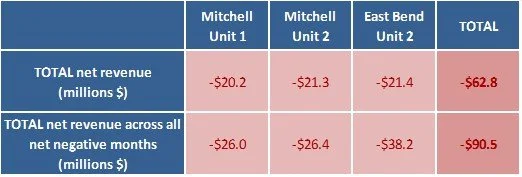
Over a two-year period spanning November 1, 2022 to October 31, 2024, AEC finds that the East Bend and Mitchell coal-fired units fared poorly in the energy market: the units collectively lost nearly $63 million on net, with each unit costing Kentucky ratepayers between $20 and $21 million. All three units had negative net revenues about 80 percent of the time over the two-year period, and when you sum across months with net negative revenues, total losses are about $90 million. Much of these losses can be attributed to the units’ owners (Duke Energy Kentucky and Kentucky Power Company) forcing these units to run uneconomically.