
• Home
  • About
    • Our People
    • Mission and Funding
    • 990 Filings
    • Governance and Disclosure Statements
  • Our Work
    • Publications
    • Newsletters
    • Equity Resources
  • Blog
  • Jobs
    • Internships
    • AEC Fellowship
    • Careers
  • Pro Bono Fund
    • Pro Bono Fund
    • Donate
    • MassCEC Empower Grant
Applied Economics Clinic
  • Home
  • About
    • Our People
    • Mission and Funding
    • 990 Filings
    • Governance and Disclosure Statements
  • Our Work
    • Publications
    • Newsletters
    • Equity Resources
  • Blog
  • Jobs
    • Internships
    • AEC Fellowship
    • Careers
  • Pro Bono Fund
    • Pro Bono Fund
    • Donate
    • MassCEC Empower Grant

Resilience in the Energy Sector: Lessons Learned from Extreme Climate Events

To build a reliable and resilient energy sector, communities must consider current and future hazards in assessing the vulnerability of their energy systems. The effects of climate events around the United States and the adaptations these communities made to be better prepared in the future provide a helpful window into the benefits of current investments in preventing future vulnerability.

Texas Medical Center Complex

In 2001, Tropical Storm Allison caused historic flooding in downtown Houston, Texas, causing extensive damage. The 700-acre Texas Medical Center complex, the largest aggregated medical campus in the United States, was shut down temporarily and suffered major losses. Water damage compromised emergency generators, switchgear, boiler, and chiller plant, leaving the Medical Center without electric power, heating and cooling, and other essential systems.

In the aftermath, the Center took steps to improve its infrastructure to withstand future floods. All critical infrastructure and program areas were relocated to higher ground and the organization developed a long-term hazard mitigation plan to reduce the impact of future extreme weather events.

The City of Greensburg, Kansas

In 2007, a 1.7-mile wide, EF-5 tornado struck the City of Greensburg, Kansas, causing severe damages; over 90 percent of buildings were affected. In the wake of the event, Greensburg, which relied heavily on fossil fuels for electrical generation, transitioned to 100 percent wind-derived electricity. In addition, all Greensburg buildings are now required to meet LEED platinum certification.

Picture1.jpg

Greenwich Hospital

In a reverse example, the Greenwich Hospital, located in Greenwich, Connecticut, proactively improved its energy infrastructure so that the facility could withstand powerful storms. The Hospital installed an energy-efficient 1,250-kW combined heat and power (CHP) system and a 2,000-kW backup generator.

As a result of Greenwich Hospital’s proactive resiliency planning, when Hurricane Sandy hit a few years after the upgrades, the Hospital was able to rely on its backup power and continue running after grid power was lost. The backup generators powered the Hospital immediately after grid power was lost and after just a few minutes the facility was able to rely on its CHP system.  

The Take-Away

There are lessons to be learned in these few examples. In Texas and Kansas, communities made changes following devastation from extreme climate events while a proactive hospital in Connecticut was able to continue running while a hurricane left the area powerless. If communities take steps towards improving their infrastructure today, they can avoid devastating losses later.

crop.jpg

Tanya Stasio Research Assistant


This is a part of the AEC Blog series

Tuesday 04.06.21
Posted by Guest User
 

Asian Americans are Disproportionately Impacted by Vehicle Air Pollution

In light of repeated incidents of anti-Asian hate in the United States, the Applied Economics Clinic reaffirms its statement on racial equity: AEC stands in solidarity with demands for racial justice, without which environmental and economic justice can never be achieved. In this regard, blog posts for this week will center the connection between environmental justice and Asian American communities.

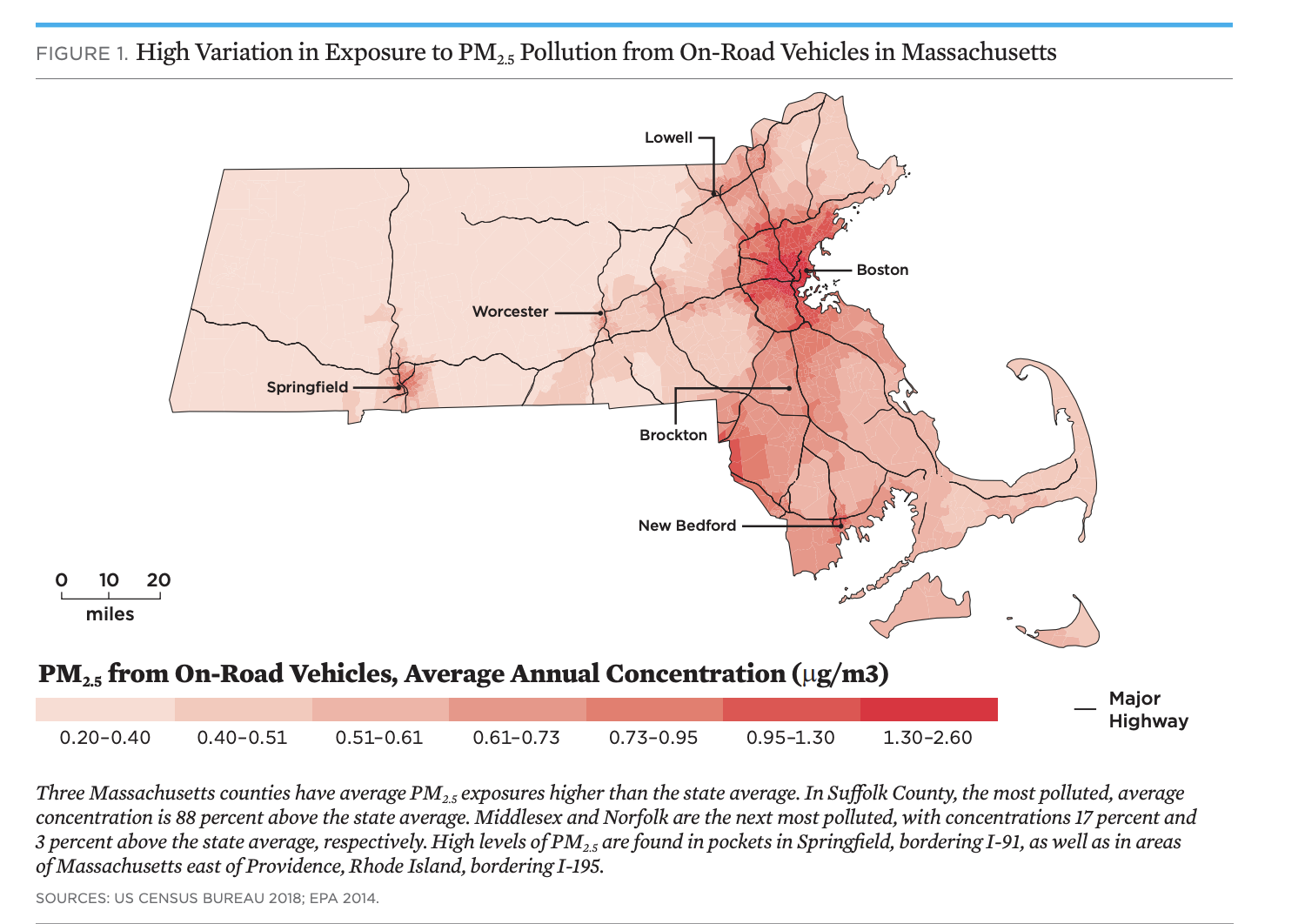
In 2019, a Union of Concerned Scientists (UCS) analysis showed that Asian American residents in Massachusetts “are exposed to PM2.5 concentrations from on-road transportation that are, on average 36 percent higher than the exposure of white residents.” Annually, 3 to 4 million deaths are attributed to air pollution from fine particulate matter; PM2.5 by itself is estimated to account for 95 percent of the global public health impact from air pollution. Exposure is associated with health conditions, including cardiovascular diseases, asthma, and slowed-lung function growth in children. In Massachusetts, worse air pollution is concentrated around downtown Boston, the I-93 and 95 corridors, and gateway cities such as Lowell. Boston’s Chinatown has the highest level of vehicle emissions of any neighborhood.

In light of the recent focus on the racism and violence faced by Asian Americans in particular, as well as the codification of environmental justice in Massachusetts’ new climate legislation, differences in air pollution by neighborhood is a timely issue. In 2017, researchers at the University of Texas, El Paso (UTEP) argued that the “model minority” label had resulted in too little focus on the environmental impacts faced by Asian Americans and that too few studies have disaggregated the damages of toxic exposure on Asian American subgroups. Studies that do are revealing. For instance, a 2010 study in Environmental Justice found that 40 percent of the Japanese population in the United States and 30 percent of the Filipino population in the United States live in counties that exceed PM2.5 air quality standards. The UTEP study also found that neighborhoods with higher proportions of Chinese, Korean, and South Asian residences have a higher risk of cancer “significantly greater cancer risk burdens relative to Whites” due to hazardous air pollutants compared to White residences.

Screen Shot 2021-04-01 at 11.27.53 AM.png

When considering how to tackle this problem, there are two places Massachusetts could start. The Applied Economics Clinic (AEC) wrote a report recommending numerous metrics to evaluate various equity and justice impacts for the Massachusetts Climate Justice Working Group’s priorities. The recommendations included building air monitoring stations for environmental justice populations and other historically marginalized communities to ensure effective data collection. New monitoring stations should be paired with a hotspot declassification standard once pollution truly falls below “hotspot” levels. AEC’s recommendations also include proposals to effectively target investment in environmental justice populations.

The second way to tackle this disproportionate exposure to air pollution is the content of environmental investments. The UCS report specifically recommends electrifying bus fleets. If begun with school busses, the benefits on student health from reduced exposure to particulate matter would be notable. Communities will also need assistance in purchasing these busses. As shown by a Massachusetts pilot, they will need assistance managing the battery infrastructure necessary to ensure energy savings from electric school buses are not lost to uncontrolled charging or to so-called “vampire loads” to maintain battery temperature. Finally, technical assistance will be necessary to ensure these busses can match time spent on the road by their diesel counterparts. For Massachusetts itself and communities with large or rapidly growing Asian American populations, attention to this policy area is imperative. It is a clear and tangible area for advancement.

Professional+Headshot+--+Chirag+Lala+(1).jpg

Chirag Lala Research Assistant


This is a part of the AEC Blog series

Thursday 04.01.21
Posted by Guest User
 

Asian Americans and Environmental Justice: Case Study of Quincy, MA

In light of repeated incidents of anti-Asian hate in the United States, the Applied Economics Clinic reaffirms its statement on racial equity: AEC stands in solidarity with demands for racial justice, without which environmental and economic justice can never be achieved. In this regard, blog posts for this week will center the connection between environmental justice and Asian American communities.

The City of Quincy has the largest Asian American population in the Greater Boston area, second only to Boston itself. Asians make up nearly 30 percent of Quincy’s population. Quincy includes census tracts that meet Massachusetts’ environmental justice communities status for indicators of: Income (Households earn 65 percent or less of the statewide household median income) or Minority (25 percent or more of the residents are racial/ethnic minorities) or both. 

Environmental justice status is especially relevant not only as it relates to the rise of anti-Asian sentiment, but also when looking at systemic indicators of racism. Environmental justice, as discussed in a prior AEC blog, is a key issue in formulating measures to mitigate climate change. By viewing climate change through the lens of environmental justice and equity, disproportionate impacts of the climate crisis can be acknowledged and rectified. Quincy is directly impacted by the Weymouth Compressor, a project that would help move gas between two pipelines, delivering gas to New England and Canada. The Weymouth project posed a direct threat via air and noise pollution to Quincy Point and Germantown, two Quincy communities with predominant Asian ethnicities (29.6 and 39.3 percent, respectively). According to October 2020 reporting by a local news station, residents impacted by the project already had “statistically higher rates of cancer, pediatric asthma, and cardiovascular respiratory diseases”, and the compressor station would exacerbate these preexisting conditions.

gettyimages-1182601890-640x640.jpg

AEC Senior Economist Liz Stanton provided testimony critiquing the project, however, it was never filed as the Town of Weymouth ultimately settled with the Enbridge, the compressor station’s developer. Nonetheless, the compressor continues to spark controversy. In March 2021, concerns regarding the need for a gas compressor station in Weymouth were elevated to the federal level, with FERC beginning a review process into the compressor. Notably, FERC Chairperson Glick publicly commented on the environmental justice concerns surrounding the compressor.

A rise in Anti-Asian racism at the societal level directly is closely related to these systemic issues, ranging from government exclusion acts to implementing harmful environmental practices to already vulnerable communities. The Weymouth Compressor project has the potential to further perpetuate inequities in environmental justice communities and, more specifically, promote a systematic undermining of underrepresented minorities, like the large Asian community in Quincy.

vsco5f33620738db5.jpg

Myisha Majumder Research Assistant


This is a part of the AEC Blog series

Tuesday 03.30.21
Posted by Guest User
 

What is missing from Biden's Climate Plan?

President Joe Biden’s $2 trillion plan to tackle climate change aims to achieve economy-wide net-zero emissions no later than 2050 and invest $400 billion into clean energy. Although the plan is ambitious, it is missing some important elements for successful climate change mitigation like addressing climate migration and infrastructure planning.

President Biden signed several executive orders re-establishing climate standards that were dismantled under the Trump administration. Biden’s goal is to make the United States carbon neutral by 2050, largely by replacing fossil fuel energy generation and transportation with renewables, which are becoming the cheapest energy sources in the United States. Today, the levelized cost of wind energy is $26 per megawatt-hour (MWh) down from $37 per MWh in 2014. In comparison, today’s gas-fired generation costs $28 per megawatt-hour.

Picture1.jpg

While some climate scientists are satisfied with the plan, others believe there are areas that need more attention. Imperial College Director of Research Dr. Joeri Rogeli celebrates the plan’s balanced transition away from fossil fuels, but expresses concern about the lack of detail on how that transition will take place. Director of Boston University’s Institute for Sustainable Energy Peter Fox-Penner thinks additional work is needed in the area of infrastructure planning—specifically to deliver clean fuels to the entire energy network. And Syracuse Associate Geology Professor Dr Farhana Sultana calls for better engagement with climate migrants in the climate plan, as she believes the United State’s contributions to climate change have left the country with a responsibility to provide aid. 

All three of the climate experts lauded Biden’s climate plan, describing it as a bold approach to climate change mitigation that would only be made better with the inclusion of additional mitigation strategies. The President’s administration needs to move quickly to achieve their carbon reduction goals, and employing more strategies will help to diversify the path to carbon neutrality.

Eliandro-001.jpg

Eliandro Tavares Assistant Researcher


This is a part of the AEC Blog series

Thursday 03.25.21
Posted by Guest User
 

Equity and Environmental Justice

Equity and environmental justice are having a moment.

It has long been acknowledged that climate change poses the gravest threats to those who did the least to cause it—people in poverty, socially and economically vulnerable populations, frontline communities. That said, “environmentalism” as such has remained a stubbornly white, wealthy endeavor. Equity and environmental justice call on environmentalists and environmentalism to go beyond matters of policy and reconceptualize what it means to “do” environmentalism or “be” an environmentalist. To acknowledge that the root causes of climate change are shared with those of other social ills like poverty, racism, and poor health outcomes. To build bigger, deeper coalitions and find allies that are representative of the communities worst affected. And to work for change. The “environment” is more than nature; it is where we work, play and live.

equity_blog.jpg

As Hurricane Katrina caused thousands of deaths and hundreds of billions in damages. As poor, minority neighborhoods are still decimated more than a decade later, even as wealthier, whiter neighborhoods have recovered.

As hundreds of unarmed Dakota Access pipeline protestors were injured after police used water cannons in below-freezing temperatures that caused bones to break and people to catch hypothermia.

As the Flint water crisis captured the nation’s attention by: demonstrating the extent to which the complaints of residents had been ignored, giving witness to thousands of children receive lead-contaminated water and people die of Legionnaire’s disease, and taking an astounding five years to resolve.

As the COVID-19 pandemic hit communities of color the hardest, due in large part to the disproportionate levels of harmful pollution in the air they breathe.

These issues (and many more) have compounded in our collective consciousness to forcefully, glaringly, and appallingly demonstrate how existing environmental policies fail to protect vulnerable and marginalized communities. As a result, equity and environmental justice are having a moment—and not a minute to soon, because equity and environmental justice are about basic human rights, fair treatment, meaningful involvement, and shared prosperity.

2017%2BHeadshots_005.jpg

Dr. Bryndis Woods Senior Researcher


This is a part of the AEC Blog series

Tuesday 03.23.21
Posted by Guest User
 

Proximity to I-93 and Environmental Justice in Somerville, MA

Somerville, Massachusetts is a city just northwest of Boston, one of the most densely populated in the country, and is bisected by several major highways. A 2019 Community Assessment of Freeway Exposure and Health (CAFEH) report focusing on the health impacts of highway proximity finds that most Interstate 93 (I-93) adjacent areas in Somerville are considered Environmental Justice communities. In 1973, the construction of the  I-93 extension through Somerville demolished an existing neighborhood and greatly reduced nearby property values. Air pollution from on-road vehicles is a major contributor to smog and poor air quality, which have important negative impacts on human health and wellbeing.

More than 75,000 people are packed into Somerville’s 4.1 square miles, the most densely populated city in New England. Neighborhoods along the I-93 corridor are some of the most densely populated areas within Somerville, and are significantly more racially and ethnically diverse than Somerville as a whole: According to the CAFEH report, roughly half of the residents in neighborhoods next to I-93 are people of color, compared to the citywide average of 30 percent. Areas along I-93, particularly the south-facing side, are also less affluent and have a higher proportion of children compared to the rest of Somerville. For near-highway residents, the installation of noise barriers would reduce sound levels and exposure to traffic-related air pollution—ultimately improving life-long health outcomes through reduced risk of heart/respiratory disease, and improved mental health.

I-93_Corridor_Somerville_aerial_1.JPG

Despite substantial evidence of health benefits and equity implications of noise/pollution barriers, Massachusetts Department of Transportation (MassDOT) plans for noise barrier installations on state highways do not include I-93 in Somerville. MassDOT’s barriers are only considered for new highway construction where noise levels will exceed a threshold standard (Type I Projects) or areas that are on MassDOT’s Type II Priority List.

As a result of not being on MassDOT’s list of cities and towns most adversely affected by highway traffic noise, I-93 in Somerville does not meet the criteria for “Priority” sound barrier project. MassDOT only measures noise to determine if sound walls are needed—air pollution is not recognized as a valid basis for barrier installation. Currently, on the north-facing side of I-93 near the newly-developed Assembly Row, the Ten Hills neighborhood does have a sound barrier—while the south-facing side, comprised of portions of East Somerville, Winter Hill, and Somerville Housing Authority’s entire Mystic River Development, does not.

As Massachusetts continues to pursue their state climate and emissions goals while planning for equity and environmental justice, transportation reform must include changes that go beyond investments in electric and hydrogen fuel cell vehicles. For true equity, the transition to a carbon-free state must address legacies of infrastructure inequality and consider improvements that benefit not only travelers, but the communities they speed through as well.

Sagal%2B2019.jpg

Sagal Alisalad Assistant Researcher


This is a part of the AEC Blog series

Thursday 03.18.21
Posted by Guest User
 

What are “Green Banks?” Different Models for the Energy Transition

Green banks are entities that provide financing and technical assistance to clean energy or energy efficiency projects to earn a profit themselves, or to finance additional rounds of funding. Many states and cities already have green banks. The Connecticut Green Bank, established in 2011, lent $36.8 million in 2020 and attracted $275.7 million in private investment. The goal of green banking is to use public funds to leverage private investment. Connecticut’s bank installed 81.6 MW of renewable electric capacity in 2020 through this effort.  The initial use of public money reduces risks for investors and demonstrates the viability of clean energy projects. A recent report by the National Academies of Science endorsed this approach and called for a green bank at the federal level.

There is debate among proponents, however, about the best path forward. Depending on the enabling legislation, a federal green bank might only be allowed to lend to state or city banks—like the one in Connecticut—rather than directly financing its own projects. Proposals also split on whether the federal bank should be a government agency or a nonprofit corporation, financially independent of the Treasury.

blog.png

Finally, the mission of a federal green bank would be crucial. Some proponents want it to both generate public and leveraged private investment and to be a coordinating vehicle for the industrial policies to install charging stations, weatherize homes, and update the grid. These proponents draw on the National Investment Authority (NIA) proposed by Saule Omarova and Robert Hockett. The NIA would also be a public asset manager or equity firm which offers financial markets alternative instruments into which investors could shift their portfolio investments. Other green bank advocates stick to what they see as the core mission: institutionalizing a source of finance that is independent of Congress’ temperamental budget process. A group of senators--including Ed Markey (D-MA) and Congresswoman Debbie Dingell (D-MI)—recently introduced the “Clean Energy and Sustainability Accelerator Act” that would fund a new nonprofit bank with $100 billion in public money and earmark 40 percent of the funds for communities “disproportionately affected by environmental pollution, climate change impacts, or economically reliant on a fossil fuel-based industry.”  As the Biden-Harris Administration considers how its infrastructure package could tackle climate change, a federal “green bank” might well be in the cards.

Professional+Headshot+--+Chirag+Lala+(1).jpg

Chirag Lala Research Assistant


This is a part of the AEC Blog series

Tuesday 03.16.21
Posted by Guest User
 

What is the Future of Gas?

A transition away from gas and towards low or zero-emission heating will require planning and coordination to achieve the most efficient and equitable outcomes. In Massachusetts, New York, Rhode Island, California, Nevada, and the District of Columbia, local agencies and utility commissions have opened investigations into the future of gas and are working with gas utilities to determine their role in a decarbonized economy. This includes assessing whether investing in building new and repairing existing gas infrastructure makes sense.

Currently, about half of U.S. households use piped utility gas to heat their homes. As states move towards achieving their climate targets, households heating with fossil fuels will need to transition to other energy sources with lower greenhouse gas emissions. Electrification—switching from burning fossil fuels to electricity—is an essential strategy to facilitate this transition. However, states must recognize that the timing and execution of this transition is key in achieving their climate goals in a cost-effective and equitable manner.

Despite climate goals and the push towards electrification, gas utilities across the country are still building more gas infrastructure and in some states, like Massachusetts, the gas distribution system is riddled with aging, leaky pipelines that need to be replaced. Leak-prone gas infrastructure (e.g., uncoated steel, cast iron, wrought iron, among other materials) results in an abundance of gas leaks that pose risks to public safety, service reliability, and environmental health.   

image.png

Despite the risks that leaky pipelines pose, does it make sense to continue investing in gas infrastructure as we transition away from fossil fuels? Gas system investments made today may be abandoned in the near future—so-called “stranded assets”—as the number of gas customers shrink dramatically over the next few decades for states to meet their long-term climate goals. However, some of today’s gas system investments in gas leak repairs and pipeline replacement may be needed to ensure that the risks posed by our gas infrastructure are minimized in the short term.

With climate targets quickly approaching, more and more local agencies and utility commissions are working closely with gas utilities and other stakeholders to determine what the future of gas utilities looks like in a decarbonized economy. As gas and other fossil fuels become less viable into future years, gas utilities’ business models must adapt to fit within a low-carbon economy by changing the type of energy they deliver or the services that they provide.

Josh.jpg

Joshua Castigliego Researcher

crop.jpg

Tanya Stasio Research Assistant


This is a part of the AEC Blog series

Thursday 03.11.21
Posted by Guest User
 

Carbon Emissions from Virtual Meetings: Should We Turn Off Our Cameras?

A recent study conducted by researchers from Purdue, Yale, and MIT links the pandemic-driven shift to remote work higher greenhouse gas emissions driven by computer videoconferencing. Despite this new demand on the electricity grid, some evidence suggests the environmental benefits of turning off those cameras may not outweigh the health costs, and the associated emissions from videoconferencing could be negligible.

The Purdue/Yale/MIT study found that one hour of videoconferencing emits 150-1,000 grams of carbon dioxide and turning off cameras could reduce emissions from web calls by 96 percent. For perspective, the average per-capita carbon emissions in the United States is 15 metric tons per year, or 42,471 grams per person per day.

GettyImages-1219452187_428049.jpg

Although the emissions from videoconferencing are not insubstantial, remote work has been shown to save energy and reduce emissions. A 2020 analysis from the International Energy Agency found that working from home is likely to reduce the carbon footprint of commuters who drive gasoline-powered cars more than 6 kilometers (3.7 miles) to work by nearly 40,000 grams CO2 per day—that’s a savings of 5,000 grams CO2 per hour in a typical work day. For those with shorter commutes, or commutes involving public transit, however, remote work may increase emissions due to extra residential energy consumption. Depending on the carbon intensity of the commute, emissions savings from remote work likely outweigh extra emissions from video calls.

Together, working remotely and eliminating videoconferencing could reduce emissions even further, but could result in unintended consequences. A letter published by Harvard Medical School argued that videoconferencing has a role in combatting the “life-threatening consequences” of loneliness and isolation. Although there is not enough evidence to prove that people will feel less lonely or isolated due to video calls, doctors at Harvard Medical School believe there is an emotional benefit to sharing meaningful conversations face-to-face, even if done virtually.


Eliandro-001.jpg

Eliandro Tavares Assistant Researcher


This is a part of the AEC Blog series

Tuesday 03.09.21
Posted by Guest User
 

Air Pollution and COVID-19

In our recent policy brief looking at COVID-19 and climate injustice, we found that there is overlap in communities disproportionately impacted by the COVID-19 pandemic and environmental justice concerns, like air pollution. Our research indicated that Black and Latinx populations have more exposure to air pollution, which puts them at greater risk for dying from COVID-19. By acknowledging these data-driven facts, policy makers can make more informed decisions for the future to appropriately remedy these injustices and protect vulnerable communities.

Picture1.jpg

President Biden’s Environmental Justice Plan incorporates the science and data-inspired decision making we highlighted in our policy brief. Most notably, the Biden Administration advocates decision making driven by data and science, including reducing the burden of air pollution on marginalized communities. The Administration also aims to create an Office of Climate Change and Health Equity, suggesting a willingness to address the complex issues that look at the intersection of multiple issues. Biden issued an executive order on January 20, 2021, with a wide variety of actions protecting public health of Americans. The order includes the reduction of air pollutants and revisiting emissions standards. As explained in our brief, health inequity in the United States continues to be amplified by climate change. Policies, like these, may be beneficial towards making advances in both the climate and health crisis.  

These federal actions serve as the first step in addressing the close relationship between environmental justice communities, those vulnerable to climate change risks, and health disparities. At the same time, they send a signal to states to take this mandate one step further and implement localized policy.

vsco5f33620738db5.jpg

Myisha Majumder Research Assistant


This is a part of the AEC Blog series

Thursday 03.04.21
Posted by Guest User
 

Climate vs. Weather

Introducing the Applied Economics Clinic Blog! Every week, we will be sharing a couple short pieces related to energy, environment, and equity. This first post covers the recent cold temperatures seen in Texas and the important differences between climate and weather.

With the below-freezing temperatures and unprecedented ice storms that blanketed the interior United States last month, it seems like a good time to remind climate naysayers and fossil fuel opportunists of the differences between global warming, weather and climate change.

Global warming: There is undisputed evidence that the average world temperature has been rising for decades and an overwhelming majority of scientists predict that temperatures will continue to grow higher for many decades to come. The cause? Excess carbon dioxide and other heat-trapping gases in our atmosphere as a result of burning fossil fuels for transportation, heating, cooling, lights and electronics.

Weather: The atmospheric conditions (temperature and precipitation) in any one spot or at any one time around the world may be the same or different than in past years. Isolated cold weather conditions, however, do not offset the trend of average global warming—across the world, most temperature readings are higher than the historical average rather than lower.

Climate change and “weather weirding”: That is not to say, however, that climate change has no impact on weather. On the contrary, climate change leads to a widespread phenomenon sometimes called “weather weirding”: It shakes things up. With climate change, historical weather patterns and local climate conditions can no longer be counted on. Cold places may have milder winters or hot summers. Hot places may have milder summers or cold winters. Rainy places dry up and dry places are flooded. It’s a mess. 

Picture1.jpg

The entire State of Texas shut down by cold conditions not found in the historical weather record? That’s weather weirding. Climate change acts to shift weather patterns, sometimes in dramatic and sudden ways. The impacts of an abrupt shift in expected weather patterns can be—as we saw last month—extremely dangerous. Texas power plants, water pipes, and heating systems were not built with the possibility of reaching these low temperatures in mind and cannot perform under these conditions: electric service shuts down, water service shuts down, piped gas delivery shuts down, and regardless of whether homes are heated with gas or electric, heating systems cease to function. No ready solutions are at hand to aid in serving immediate needs because the problems are outside of the range of past experience. And the long-term solutions are very expensive: Going forward, Texas will need energy and water systems that can withstand not only very high temperatures but also very low temperatures.

Texas’ hardships highlight another important thing to remember about global warming, climate change and weather weirding: The worst impacts are visited on those who are least able to protect themselves. The rich can afford back-up heating systems and electric generators, have water delivered, or just take a vacation, while poor families—including those made newly homeless or otherwise destitute due to the pandemic—stand in line for supplies, light air-poisoning fires or bring carbon monoxide-emitting equipment inside their homes to keep their kids from freezing, and dread the loss of paycheck that will come for wage laborers who are out of work from all the businesses closed by the freezing temperatures.

Weather is a problem for today: pick the right coat to wear, bring an umbrella, stay at home for a snow day. Climate change is the larger pattern of problems that need systematic, cooperative solutions across communities and across the world as a whole: rapid reduction of greenhouse gas emission, infrastructure that can withstand sometimes dramatic shifts in climatic conditions, and protection of basic needs for vulnerable communities.

2017%2BHeadshots_003.jpg

Dr. Liz Stanton Director and Senior Economist


This is a part of the AEC Blog series

Tuesday 03.02.21
Posted by Liz Stanton
 
Newer / Older