
Client: Better Future Project
Authors: Jordan Burt, PhD, Sagal Alisalad, Elizabeth A Stanton, PhD
October 2026
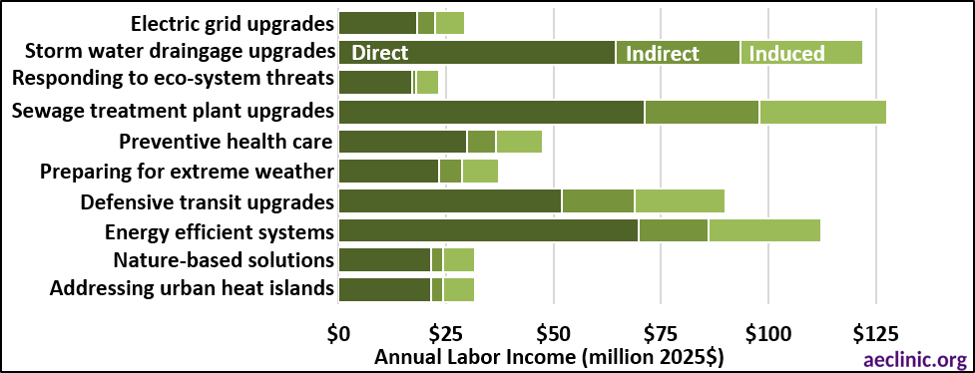
On behalf of Better Future Project, Researchers Jordan Burt, PhD and Sagal Alisalad, and Principal Economist Elizabeth A. Stanton, PhD prepared a report that summarizes the benefits establishing the Climate Change Superfund (Senate Bill No. 588) would have across Massachusetts. The report finds that investing in climate adaptation through the Climate Change Superfund could create thousands of jobs, generate substantial economic and labor income benefits, improve public health and environmental quality, and reduce pressure on the Commonwealth’s budget. AEC’s analysis focuses on the ten climate change adaptation projects outlined in the Bill and identifies various co-benefits, such as reduced pollution exposure, expanded green spaces, increased labor and economic productivity. The analysis also finds that using the Climate Change Superfund to support such adaptation projects could lower the Commonwealth’s budget expenditures, reducing the amount of revenue needed to operate the state government at its current level and potentially creating opportunities to a reduce the state’s income tax rate. Modeling conducted by the Political Economy Research Institute (PERI) in 2025 indicates spending $1 billion per year on adaptation projects will create approximately 7,650 jobs per year with an average labor income of $81,380.