
Client: Sierra Club
Author: Liz Stanton, PhD, Joshua R. Castigliego, Jordan Burt, PhD, and Bryndis Woods, PhD
April 2026
AEC-2026-04-WP-01
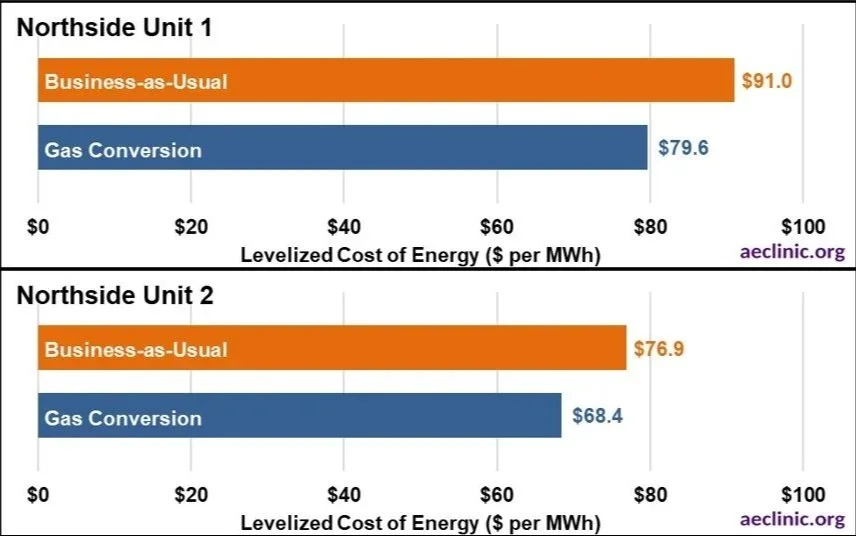
On behalf of Sierra Club, Principal Economist Elizabeth A. Stanton, PhD, Senior Researcher Joshua R. Castigliego, Researcher Jordan Burt, PhD, and Principal Analyst Bryndis Woods, PhD, prepared a white paper that investigates the potential cost savings associated with transitioning JEA’s Northside Generation Station to retire its coal-fired operations and run exclusively on natural gas. Using a simple model of annual expenses and revenues at the unit for the period 2026 to 2035, AEC compared net costs under a “business-as-usual” scenario in which the operations of recent historical years continue into the future with a “gas conversion” scenario in which full-time gas operations commence in 2030. Over the 10-year modeling period, elimination of all coal operations at Northside Units 1 and 2 result in a total savings of $122.8 million, or $51.9 million at Northside Unit 1 and $70.9 million at Unit 2. Northside Unit 1’s levelized costs fall by $11.4 per MWh and Unit 2’s by $8.5 per MWh.
A cost savings opportunity of this magnitude—approximately 12 percent reduction from current Northside 1 and 2 costs—deserves careful and transparent examination. Utility decisions regarding capital investments, maintaining aging infrastructure, and day-to-day operations must consider affordability and keep an open mind to new options for lowering costs. To achieve a successful conversion at Northside Units 1 and 2, AEC recommends that JEA conduct and publicly share a comparative analysis of its future operations (including all fixed, variable, and capital costs and financing) under current mixed fuel operations and under all gas operations. All assumptions, data, and methodologies should be fully transparent and made publicly available, and JEA’s analysis should also assess the conversion’s impact on rates and customer bills.