Long-duration energy storage (LDES) is a vital part of a clean energy future, storing renewable energy for periods up to 100 hours. These technologies come with varying price tags. Levelized cost of storage (LCOS, the cost per unit of energy delivered) is a measure of LDES technologies cost effectiveness. LCOS varies with both system configuration and capacity factor, that is, whether a storage is highly utilized or not.
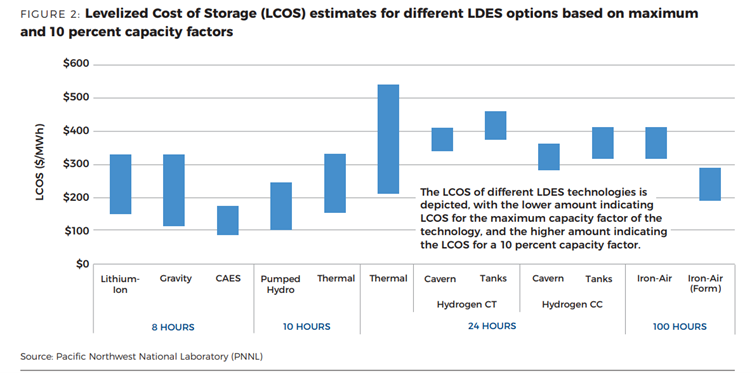
Source: Clean Energy Group, Evaluating Hydrogen for Long Duration Energy Storage: Costs, Risks, and Equity Considerations, July 2025.
On the whole, short-duration storage is more expensive per kWh than long-duration systems. The cost of compressed air energy storage (CAES), for example, depends on its configuration. A 1000-watt CAES system with storage of 100-hours costs $15/kWh, but a 4-hour storage system costs around $248/kWh. Similarly, long-duration lithium-ion batteries are less expensive than short-duration.
LCOS varies inversely with capacity factor or system utilization. Higher LCOS is associated with lower capacity factors. For instance, hydrogen storage units usually operate at very low-capacity factors (e.g., 5 percent). At these low storage utilization levels, the LCOS of hydrogen LDES rises by nearly $200/MWh from $400/MWh at 10 percent capacity factor.
There is no universal right choice for all applications. Choosing the appropriate technology can reduce costs while contributing to a cleaner and more equitable future.