
• Home
  • About
    • Our People
    • Mission and Funding
    • 990 Filings
    • Governance and Disclosure Statements
  • Our Work
    • Publications
    • Newsletters
    • Equity Resources
  • Blog
  • Jobs
    • Internships
    • AEC Fellowship
    • Careers
  • Pro Bono Fund
    • Pro Bono Fund
    • Donate
    • MassCEC Empower Grant
Applied Economics Clinic
  • Home
  • About
    • Our People
    • Mission and Funding
    • 990 Filings
    • Governance and Disclosure Statements
  • Our Work
    • Publications
    • Newsletters
    • Equity Resources
  • Blog
  • Jobs
    • Internships
    • AEC Fellowship
    • Careers
  • Pro Bono Fund
    • Pro Bono Fund
    • Donate
    • MassCEC Empower Grant

Choosing the Right Energy Storage Technology: A Cost-Effective Approach

Long-duration energy storage (LDES) is a vital part of a clean energy future, storing renewable energy for periods up to 100 hours. These technologies come with varying price tags. Levelized cost of storage (LCOS, the cost per unit of energy delivered) is a measure of LDES technologies cost effectiveness. LCOS varies with both system configuration and capacity factor, that is, whether a storage is highly utilized or not.
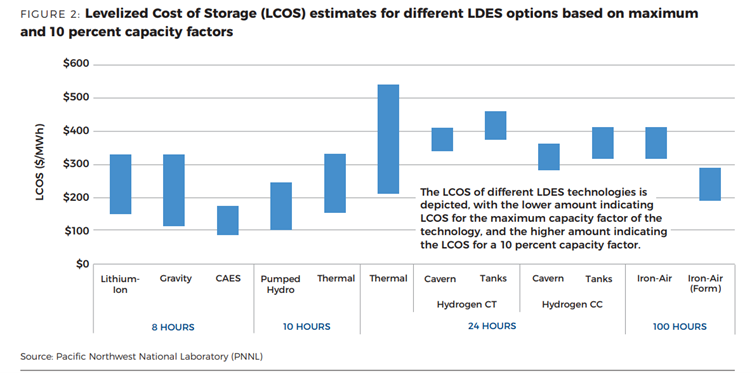
Source: Clean Energy Group, Evaluating Hydrogen for Long Duration Energy Storage: Costs, Risks, and Equity Considerations, July 2025.

On the whole, short-duration storage is more expensive per kWh than long-duration systems. The cost of compressed air energy storage (CAES), for example, depends on its configuration. A 1000-watt CAES system with storage of 100-hours costs $15/kWh, but a 4-hour storage system costs around $248/kWh. Similarly, long-duration lithium-ion batteries are less expensive than short-duration.

LCOS varies inversely with capacity factor or system utilization. Higher LCOS is associated with lower capacity factors. For instance, hydrogen storage units usually operate at very low-capacity factors (e.g., 5 percent). At these low storage utilization levels, the LCOS of hydrogen LDES rises by nearly $200/MWh from $400/MWh at 10 percent capacity factor.

There is no universal right choice for all applications. Choosing the appropriate technology can reduce costs while contributing to a cleaner and more equitable future.

Jheelum Sarkar

Research Assistant


This is a part of the AEC Blog series.

tags: Jheelum Sarkar
Monday 12.01.25
Posted by Liz Stanton
 

Coal Plant Retirements Dominate U.S. Power Sector Shift

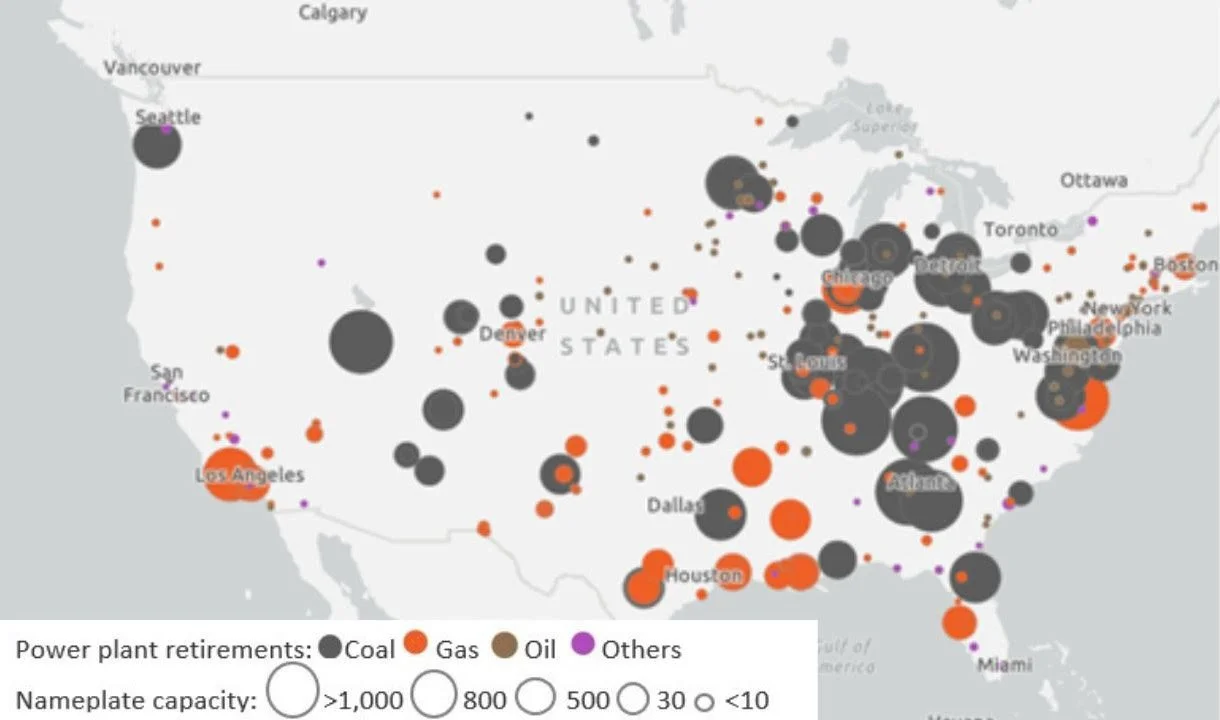
More than 93 GW of U.S. power plant capacity is set to retire by 2030. Coal plant closure is expected to make up two-thirds of all retiring capacity during 2022-2030. This shift has important implications for both grid reliability and emissions since cleaner energy resources are gradually replacing coal plants.

Image Source: U.S. Environmental Protection Agency, Office of Air and Radiation (OAR); Map data from Esri, TomTom, FAO, NOAA, USGS, and NRCan; Legend added by the Applied Economics Clinic.

The Midwest, Mid-Atlantic and Southeast regions lead in major planned coal shutdowns. If these retiring coal plants are replaced with clean energy sources such as wind and solar, nearby communities could benefit from reduced air pollution and public health benefits. Moreover, smaller retiring coal plants scattered across the West and Southwest indicate that the coal retirements are not limited to just the coal-heavy regions.

The gradual phasing out of coal plants reflects a structural shift in U.S. electricity generation away from high-emission energy sources. What replaces these plants will determine whether the changes are beneficial for sustainable development goals in the coming decades.

Jheelum Sarkar

Research Assistant


This is a part of the AEC Blog series.

tags: Jheelum Sarkar
Wednesday 08.13.25
Posted by Liz Stanton