• Home
  • About
    • Our People
    • Mission and Funding
    • 990 Filings
    • Governance and Disclosure Statements
  • Our Work
    • Publications
    • Newsletters
    • Equity Resources
  • Blog
  • Jobs
    • Internships
    • AEC Fellowship
    • Careers
  • Pro Bono Fund
    • Pro Bono Fund
    • Donate
    • MassCEC Empower Grant
Applied Economics Clinic
  • Home
  • About
    • Our People
    • Mission and Funding
    • 990 Filings
    • Governance and Disclosure Statements
  • Our Work
    • Publications
    • Newsletters
    • Equity Resources
  • Blog
  • Jobs
    • Internships
    • AEC Fellowship
    • Careers
  • Pro Bono Fund
    • Pro Bono Fund
    • Donate
    • MassCEC Empower Grant

Non-Energy Benefits of Energy Programs

Midwest Energy Efficiency Alliance. n.d. Non-Energy Benefits of Energy Efficiency. Available at: https://www.mwalliance.org/sites/default/files/media/NEBs-Factsheet_0.pdf

Energy-related program assessments take account of the “non-energy benefits” (NEBs) that place a value on the many and diverse benefits for participants in energy efficiency programs beyond energy savings. Three-quarters of energy efficiency project benefits can come from NEBs including reduced energy burden for low-income residents, improved health and wellbeing, and a reduction in societal costs from air pollutants from fossil-fuel burning.

Regulators and utilities assess the cost-effectiveness of their energy efficiency programs by comparing the benefits of the program to the cost of delivering those programs. Forty states, including Texas, Florida, Ohio, and Pennsylvania, use cost-benefit tests that do not incorporate NEBs. The remaining 18 continental U.S. states that do incorporate NEBs, such as California, Massachusetts, and Washington, face challenges in quantifying NEBs. One difficulty is determining whether benefits are specific to the energy efficiency program itself, or whether they are caused by a different activity. For example, asthma incidences may be reduced by the reduction in energy derived from pollutant-emitting fossil fuels such as coal. But other initiatives, such as reducing exposure to tobacco smoke or mold, can also contribute to this reduction in asthma prevalence but which then cannot count as a NEB.

Further, reported monetization values for individual NEBs vary, due to different methods and assumptions used as well as differences in households, climate, and programs. Values may differ based on whether NEBs are included in a cost-benefit analysis:

  • As an adder, which is a dollar or percentage value added to energy benefits;

  • Using quantification, or the inclusion of money values for NEBs that can be quantified, such as a reduction in ratepayer costs; or

  • As a hybrid of both an adder and quantification, where an adder represents certain NEBs and quantification is used for others.

Regardless of the method used, accounting for NEBs in state policy and utility planning allows for the full potential and opportunities of energy efficiency programs to be captured.

Alicia Zhang

Research Assistant


This is a part of the AEC Blog series

tags: Alicia Zhang
Wednesday 06.07.23
Posted by Liz Stanton
 

A Moratorium on New Gas System Expansion

Based on remarks made at a Massachusetts State House briefing on 6/6/2023:

Investment in new gas infrastructure is costly for Massachusetts utility customers. Better, and less costly, alternatives exist.

  • Fossil gas must be phased out by 2050 to comply with Massachusetts’ net zero greenhouse gas emissions requirement.

  • By 2050 at the latest, therefore, oil and gas pipelines, storage facilities, and power plants will need to be retired. Most facilities will need to be retired sooner; Massachusetts law sets intermediate emission reduction targets of 50 percent below 1990 levels by 2030 and 75 percent by 2040. Facilities that retire before the end of their economic lifetime face accelerated depreciation creating stranded assets that must still be paid for in utility customers’ rates and bills, even when the facilities are no longer in operation. These are costs paid for by consumers with no benefit to consumers.

  • Over the next three decades, the number of customers on the gas system will plummet. In the residential sector, Massachusetts’ Clean Energy and Climate Plan calls for more than half of all households to be heating with electricity by 2035 and 85 percent by 2050. Richer households with access to upfront funds, credit sources, and the financial facility to assume risks or take on investments with five-, ten- or twenty-year payback periods will leave the gas system first.

  • As a result, the fixed cost of the gas system will be shared with a shrinking customer base, driving up energy bills for the households that do not have the financial means to decarbonize their heating systems. The households who are left behind on the gas system, paying higher fixed costs every year, are disproportionately households with lower incomes, renter households, and those living in environmental justice communities.

Second, the restoration and refueling of Massachusetts’ aging and leaky gas infrastructure is costly for Massachusetts utility customers and presents a danger to all homes, schools and businesses located nearby.

  • As fossil gas is phased out to comply with Massachusetts climate standards, some advocates for spending utility customers’ money to rebuild aging gas pipelines call for a transition to using the same infrastructure to deliver different highly combustible fuels: a mix of upgraded biogas and hydrogen.

  • Our research at the Applied Economics Clinic has, repeatedly, found:

    • a lack of evidence that a sufficient supply of these alternative fuels will be available to meet customer needs;

    • that, if supplied in high volumes, these fuels are far more costly than the fossil gas that utilities supply today;

    • that upgraded biogas and hydrogen are only zero carbon under very special circumstances; and

    • that these alternative fuels pose significant dangers to human health and safety from leaks and accidental combustion or explosion.

  • Continued investment in repairing leaks and rebuilding the Commonwealth’s gas infrastructure has already cost ratepayers billions of dollars.

  • Gas pipeline replacement is estimated to cost an additional $16-$17 billion—an amount that would take more than 90 years to pay off using the $5 per month “GSEP charge” currently paid on each gas bill. Factoring in the expected drop in the number of gas customers over time as more and more customers switch to electric heating, it would require a GSEP charge of about $30 per month, to pay off the total costs of pipeline replacements by 2050.

Investments in both new and existing fossil fuel infrastructure are not economic. Immediate repairs of dangerous leaks are essential to public safety, but a comprehensive $17 billion pipe replacement program cannot be paid for without increasing charges on gas bills. Richer families have been fleeing, and will continue to flee, the gas system, raising bills for the remaining lower-income families who will be left holding the bag. Massachusetts needs a strategic plan for economically, and equitably, walking away from gas. An end to fossil gas will still happen without such a plan, but it will cost us more, and cost Massachusetts’ overburdened communities the most.

Liz Stanton, PhD

Director & Senior Economist


This is a part of the AEC Blog series

tags: Liz Stanton
Wednesday 06.07.23
Posted by Liz Stanton
 

Atmospheric carbon dioxide levels continue to hit record levels. What can we do to decarbonize?

Image Credit : https://www.climate.gov/news-features/understanding-climate/climate-change-atmospheric-carbon-dioxide

In 2022, the global average concentration of atmospheric carbon dioxide (CO2) hit a record high of 417 parts per million (ppm) and continues to rise at a rate of around 2 ppm per year. Atmospheric CO2 levels have been on the rise since the beginning of the Industrial Revolution; before industrialization, CO2 levels remained stable below 300 ppm for thousands of years. Today’s CO2 concentrations are the highest level in at least 800,000 years.

This rapid climb—largely due to human activities, primarily the burning of fossil fuels, deforestation, and industrial processes—has emerged as one of the most pressing challenges in modern history. Rising CO2levels contribute to climate change, causing detrimental impacts on ecosystems, weather patterns, and human health. It’s not too late to decarbonize, but successfully zeroing out new emissions and reducing atmospheric concentrations will require immediate action.

Rising greenhouse gas concentrations lead to global warming, sea-level rise, ocean acidification, and the intensification of extreme weather events, such as hurricanes, droughts, and heatwaves. The consequences of elevated CO2 levels are intersectional and impact communities disproportionately, exposing low income and black, Indigenous and people of color (BIPOC) to higher rates of environmental hazards. Designing equitable protection from the effects of rising CO2 levels is imperative to close existing racial gaps.  

Among many promising solutions that, together, can reduce atmospheric CO2 here are five that are proven and are capable of addressing environmental justice concerns when designed appropriately:

1.     Renewable energy paired with electrification:

Shifting away from fossil fuels in favor of renewable energy sources is crucial to decarbonize our energy sector. Solar, wind, hydro, and geothermal power have become increasingly affordable and accessible, offering cleaner alternatives to traditional coal, oil, and gas. When paired with battery storage and demand response technologies, these sources can sustainably power communities with minimal support from carbon emitting energy sources.

2.     Energy efficiency:

Enhancing the energy performance of buildings, transportation systems, and industrial processes can significantly reduce energy consumption and associated CO2 emissions. Energy-efficient technologies, smart grid systems, and energy management practices can help optimize energy use while reducing carbon footprints. Incentive programs can ensure low-cost access to these services based on income or background.

3.     Electrification of transportation:

Getting more people out of personal vehicles will reduce the energy consumption demands of transportation. Promoting and incentivizing public and active transportation (like biking and walking) in densely populated areas can reduce congestion while making transportation options more accessible to justice communities[LS1] . Paired with electric cars and greatly increasing the availability of charging stations, public and active transportation can decarbonize transportation without decreasing accessibility.

4.     Reforestation and Land Management:

Forest ecosystems are natural carbon “sinks” that absorb CO2 from the atmosphere. Protecting existing forests and implementing large-scale reforestation initiatives through sustainable land management practices, including soil carbon sequestration and regenerative agriculture, can contribute to carbon removal and restore ecosystems. These restoration programs can be focused around low-income communities where green coverage tends to be more sparse.

5.     Circular Economy and Sustainable Production:

Transitioning towards a circular economy—where resources are efficiently used, recycled, and waste is minimized—can significantly reduce CO2 emissions. Sustainable production processes, such as the use of renewable materials, eco-design principles, and recycling initiatives, are crucial for achieving carbon neutrality across all economic sectors, including manufacturing and construction.

Efforts to address climate change and decarbonization must go hand in hand with social and economic justice to ensure a just transition. By acknowledging and actively working to rectify the disproportionate impacts, we can build a more inclusive and sustainable future for all.

Eliandro Tavares

Assistant Researcher


This is a part of the AEC Blog series

tags: Eliandro Tavares
Wednesday 05.24.23
Posted by Liz Stanton
 

Massachusetts' Renewables Requirements Only Apply to 86 percent of Electric Customers

Supplying 14 percent of customers electric demand, Massachusetts Municipal Light Plants (MLPs) are not required to comply with the Commonwealth’s Renewable Portfolio Standard  or Clean Energy Standard. Both standards aim to reduce emissions from the electric sector by requiring increasing shares of electric sales to the other 86 percent of Massachusetts customers to be derived from renewable resources like wind or solar.

Instead, starting in 2030 MLPs will be required to follow the provisions of the Greenhouse Gas Emissions Standard that does not require additional renewable resources for compliance. While MLPs could choose to meet the GGES with wind and solar, they are not required to, and could meet the Greenhouse Gas Emissions Standard with no additional wind or solar generation. AEC’s recent presentation on the topic demonstrates that requiring MLPs to comply with the Renewable Portfolio Standard would result in substantially higher levels of wind and solar in the Commonwealth today and into the future.

 According to data analysis performed by the Massachusetts Climate Action Network, just 2 percent of total MLP electric sales were derived from renewable energy sources in 2020. In contrast, Clean Energy Standard requires investor-owned utilities (National Grid, Eversource, and Unitil) to certify 20 percent of their electric sales as renewable in 2020. In 2030, Clean Energy Standard requires investor-owned utilities to have 60 percent renewable electric sales; MLP’s requirement for wind and solar derived resources will still be zero.

MLP’s exemption from the Renewable Portfolio Standard hinders the Commonwealth’s efforts to meet statewide climate targets and supports MLP’s continued reliance on fossil fuel resources.

Tanya Stasio

Researcher


This is a part of the AEC Blog series

tags: Tanya Stasio
Friday 05.12.23
Posted by Liz Stanton
 

Renewable Energy: Hydropower

Source: Tennessee Valley Authority

Energy and water are interdependent resources when it comes to hydroelectricity. Due to population growth, climate change, and economic growth, increased demand, and regional constraints, access to both water and energy could cause availability concerns. Human cultures have a long history using waterpower to run wheels to process grains or lumber and produce mechanical energy; this same power has evolved to become one of the largest sources of renewable electricity generation in the United States.

Out of all renewable resources, hydropower produced the most electricity in the United States until 2019. Currently, with new policies around windmill farm production, wind power generates the most electricity. In addition, hydropower’s smaller share of generation can also be attributed to the spread of COVID-19 which caused stalled licensing and project development and increases in other electric generation from sources such as nuclear plants, coal, natural gas, or other renewable energy (solar, biomass, and geothermal).

The benefits of hydroelectricity include being a clean cost-effective source, a backup to our power grids during outages or disruptions, a flood control, and an irrigation support. Hydropower projects usually have longer pre-development construction and operational timelines than other renewable sources such as wind and solar, so renewable energy policy efforts have been focused on solar and wind technology.  

Deja Torrence

Assistant Researcher


This is a part of the AEC Blog series

tags: Deja Torrence
Friday 04.28.23
Posted by Liz Stanton
 

Proactive Steps for Warm Weather Energy Efficiency

Source: PJM. n.d. “How Energy Use Varies with the Seasons.” Available at: https://learn.pjm.com/three-priorities/keeping-the-lights-on/how-energy-use-varies

Household demand for electricity often increases in the winter months due to use of heating equipment and an increased need for lights. With winter at a close and warm weather on the horizon, electric demand is expected to decrease. However, low spring electric demand will quickly be replaced by high demand in the summer due to cooling needs, which often surpass average daily demand in the winter. Massachusetts residents may benefit from a potential electric price decrease from utilities this spring, but mindful energy use and energy efficiency can further reduce electric bills.

There are a variety of ways households can be proactive in increasing energy efficiency and reducing their electric bills this summer. The U.S. Department of Energy (DOE) recommends servicing cooling systems (e.g., replacing air filters and checking evaporator coil)  in the spring to ensure they will run efficiently in the summer. DOE also recommends keeping air conditioner thermostats as high as possible, as colder settings will not cool homes faster and can result in increased costs. Installing window treatments early in the season will also help to keep homes cool: 76 percent of the sunlight that shines on windows enters the home as heat.

For additional measures households can take to improve energy efficiency this spring see the DOE’s 10 Energy Saving Tips for Spring.


Jordan Burt

Research Assistant


This is a part of the AEC Blog series

tags: Jordan Burt
Monday 04.10.23
Posted by Liz Stanton
 

Microgrids: Creating a More Sustainable and Independent Grid

Microgrids are localized energy systems that can disconnect from the traditional grid to operate autonomously. The ability of microgrid systems to disconnect (or “island”) from the traditional grid presents benefits of energy independence and flexibility, and, depending on the way they are designed, can be sustainable and cost-effective. Microgrids fill a niche that traditional grids struggle to fill, such as being designed with specific needs in mind and retaining reliable power during extreme weather events, cyber attacks, or other grid shutdown events.

On the day to day, microgrids can improve grid resilience while lowering electric bills. The “islanding” ability of microgrids ensures uninterrupted electric service when the rest of the grid may be interrupted. Furthermore, the proximity of microgrids to their customers eliminates the need for transmission lines, which charge costly fees and lose hard-earned electricity over long distances. The better resilience, efficiency, and cost-effectiveness of microgrids prove especially vital for vulnerable populations, who experience more service interruptions while paying disproportionately more out of pocket. In Boston, the bottom quarter of low-income households spend nearly a fifth (19 percent) of their income on energy bills. The autonomy of the microgrid allows for communities to implement renewable generation, such as community solar, which can improve the sustainability of their energy diet.

Microgrids demonstrate significant promise to improve the reliability, sustainability, and cost-effectiveness of electricity provision to communities of all types, finding niches in the gaps that traditional grid infrastructure struggles to fill. To learn more about microgrids and their benefits, drawbacks, and barriers to implementation, check out Applied Economic Clinic’s policy brief.


David Jiang

Research Assistant


This is a part of the AEC Blog series

tags: David Jiang
Monday 03.20.23
Posted by Liz Stanton
 

Scope 3 Accounting is Difficult, But Necessary

The U.S. Environmental Protection Program (EPA) breaks carbon emissions into three different “scopes”: direct use of fuels (Scope 1), fuel use for generating electricity (Scope 2), and more indirect upstream and downstream emissions (Scope 3). Scope 3 emissions result from activities that are not done by the reporting organization but may be done by its suppliers or vendors, such as emissions from employees commuting or emissions from purchased goods or services.

Source: World Resources Institute and World Business Council for Sustainable Development. 2011. Corporate Value Chain (Scope 3) Accounting and Reporting Standard. Available at: https://ghgprotocol.org/sites/default/files/standards/Corporate-Value-Chain-Accounting-Reporing-Standard_041613_2.pdf

For most companies, Scope 3 accounts for more than 70 percent of their carbon footprint and therefore represents a large opportunity to reduce its overall emissions. Estimating the scale of Scope 3 emissions, however, is difficult, time-consuming, and resource intensive. These challenges often lead to poor or nonexistent reporting, partially [ES1] because businesses typically require data from many different suppliers to calculate their Scope 3 emissions. In lieu of robust and complete data, Scope 3 emissions can be estimated using computer models, although the results may not be detailed enough to provide good company-specific results. The complexities of Scope 3 reporting may have to be resolved soon, as there is increasing pressure from regulatory agencies such as the International Sustainability Standards Board (ISSB) and the U.S. Securities and Exchange Commission (SEC) to require Scope 3 disclosures.

Alicia Zhang

Research Assistant


This is a part of the AEC Blog series

tags: Alicia Zhang
Monday 02.27.23
Posted by Liz Stanton
 

Individual and Environmental Risks of Gas Stoves

A study recently published in the international Journal of Environmental Research and Public Health found that on average, about 13 percent of childhood asthma in the United States is attributable to gas stove use. Pennsylvania, Massachusetts, New York, California, and Illinois are all above the national average, with 21 percent of childhood asthma attributed to gas stove use in Illinois. Gas stoves emit pollutants such as methane, nitrogen dioxide, carbon monoxide, and formaldehyde. When released indoors, even in low concentrations, these toxic gases can worsen breathing problems for residents that already have asthma.

The use of gas stoves is harmful to the environment as well. Methane leaks occur throughout the entirety of the fuel production and supply chain that allows for the operation of gas stoves.  Despite the risks to public health and the environment, more than one-third of U.S. households are currently cooking on a gas stove. Replacing a gas stove with a modern electric induction stove may not be an option due to the high cost of buying a new appliance. For households that are not able to replace their gas stoves immediately, there are still ways to minimize the effects of harmful pollutants. For example, good ventilation when cooking—by using the range hood fan and opening windows—can reduce indoor air pollution.

Elisabeth Seliga

Assistant Researcher


Nicole Yang

Communications Assistant


This is a part of the AEC Blog series

tags: Elisabeth Seliga, Nicole Yang
Tuesday 02.07.23
Posted by Liz Stanton
 

Cool Strategies in Reducing the Heat Island Effect

The cool roofs strategy, which involves converting dark surfaces, such as roofs and street pavements, to light colored and reflective surfaces is being implemented in cities across the United States to help reduce the heat island effect.  Roofs can be converted simply by applying a special reflective coating or by selecting materials that are lighter colored and have a higher solar reflectance. Pavements can also have a special reflective coating applied or permeable grass pavements can be added, which also help with stormwater filtration. The conversion to cool surfaces can help reduce pollution, energy costs, and reduce heat since 60 percent of city surfaces are covered by roofs and pavements surfaces.

Source: Global Cool Cities Alliance. (2012). A Practical Guide to Cool Roofs and Cool Pavements. Available at: https://www.coolrooftoolkit.org/wp-content/pdfs/CoolRoofToolkit_Full.pdf

Solar reflectance, also known as albedo, is measured from 0-1 to determine the efficiency to keep a surface cool (see Figure above). Lighter colored roofs and pavements have a higher albedo, meaning, with a higher reflection, the sunlight and heat bounces off of a surface more quickly. The power of reflection helps keep neighborhoods and buildings cool. Dark surfaces, with low albedo, on the other hand do the opposite. The dark surface reflects sunlight slower and absorbs more heat that is then slowly released throughout the day, making a neighborhood warmer. The Figures below compare a black and white roof and their solar radiation into the environment and absorption within a building. The 3 percent difference of heat entering the building from a lighter colored roof can be substantial for households in heat islands.

Source: Global Cool Cities Alliance. (2012). A Practical Guide to Cool Roofs and Cool Pavements. Available at: https://www.coolrooftoolkit.org/wp-content/pdfs/CoolRoofToolkit_Full.pdf

Fernanda De La Torre

Research Assistant


This is a part of the AEC Blog series

tags: Fernanda De La Torre
Friday 01.13.23
Posted by Liz Stanton
 

Energy Insecurity for Renters

Source: American Council for an Energy-Efficient Economy (ACEEE). 2022. One-Third of Tenants Behind on Utility Bills, Highlighting Need for Energy Upgrades. Available at: https://www.aceee.org/blog-post/2022/08/one-third-tenants-behind-utility-bills-highlighting-need-energy-upgrades

In winter months, as temperatures begin to fall, many households in regions across the United States fall behind on their energy bill payments. Often called energy insecurity the inability to pay energy bills can lead families to take out high risk loans, forgo buying food or medicine in order to pay their energy bill, or risk unsafe measures to heat or light their homes. Renters in particular have a high likelihood of becoming energy insecure, with 33 percent of the United States’ 44 million renters struggling to pay their energy costs last year. Renters often live in older, less energy-efficient buildings, which can increase their energy burden (which means that they have to spend a higher share of their income on heating and electricity).

On top of the standard obstacles to making a home more energy-efficient, such as high costs, renters face an extra barrier: They must go through their landlord to add insulation, upgrade to more efficient appliances, or switch to high-efficiency heat pumps for heating. Given lower rental income since the onset of the COVID-19 pandemic, however, studies have shown that landlords are unlikely to make energy-efficient changes without incentives. The Inflation Reduction Act, passed in August of this year, funds new incentive programs to landlords who make energy-efficient changes to their properties.

Nicole Yang

Communications Assistant


This is a part of the AEC Blog series

tags: Nicole Yang
Thursday 12.22.22
Posted by Liz Stanton
 

Rising Prices: The Cause of Higher Heating Bills This Winter

Source: Massachusetts Department of Energy Resources. 2022. Massachusetts Household Heating Costs. Available at: https://www.mass.gov/info-details/massachusetts-household-heating-costs#comparing-heating-technologies-to-save-on-your-heating-bills-

Higher heating costs are predicted this winter by the Massachusetts Department of Energy Resources due to higher-than-average fuel and electricity prices. In the 2022/2023 Winter report, Massachusetts Household Heating Costs, the Massachusetts Department of Energy Resources predicts electricity rates to be 40 cents per kWh in the Commonwealth, compared to 27 cents last winter. The report indicates that the exact changes to heating costs will vary based on the technology used to heat the home. For example, households using heat pumps pay one third of the cost of those using electric resistance heating (see Figure 2).  

Source: Massachusetts Department of Energy Resources. 2022. Massachusetts Household Heating Costs. Available at: https://www.mass.gov/info-details/massachusetts-household-heating-costs#comparing-heating-technologies-to-save-on-your-heating-bills-

In the wake of electricity price increases, Massachusetts’ electric utility National Grid announced a 64 percent jump in residential customers electric bills this winter. According to American Council for an Energy-Efficient Economy, low-income and BIPOC households already face higher energy burdens, making them particularly vulnerable to increases in energy bills. To help mitigate the impact of rising prices, National Grid launched a Winter Customer Savings Initiative, which helps with bill management and provides payment assistances programs. Eligible homeowners and renters may also receive help with their energy bills through Massachusetts Home Energy Assistance Program. 

Jordan Burt

Research Assistant


This is a part of the AEC Blog series

tags: Jordan Burt
Thursday 12.15.22
Posted by Liz Stanton
 

Sustainable Finance: Potential and Shortcomings

Sustainable Finance, or “green finance”, refers to emerging investment decisions that incorporate an economic activity's environmental, social and governance (ESG) impacts into the overall value of an investment or project. Traditionally, investment profits have not accounted for negative externalities such as environmental impacts of operations or unfair compensation. Sustainable finance aims to stimulate positive social externalities by incentivizing consumers to invest in companies that utilize an internal sustainability framework, or corporate social responsibility objectives, to measure ESG impacts.

Source: Olsen, H.F. 2021. What is ESG? [image]. Fiduciary Trust. Available at: https://www.fiduciary-trust.com/insights/sustainable-investing/

Financial brokers like Fidelity have begun promoting green investments to help consumers navigate the sustainable finance market. On the same note, a recent study revealed a demand for ESG-conscious products, showing 50 percent of U.S. Gen Z shoppers are willing to pay more for products that they believe are produced by companies with sustainable production practices. As a reflection of this trend, global sustainable finance investments saw a 55 percent increase from 2016 to 2020 across five major financial markets. In addition, Refinitiv’s 2021 Global Risk and Compliance report, reviewing changes in the financial risk landscape, found that 43 percent of compliance and risk professionals agreed that the global pandemic has heightened the importance of ESG factors in decision making.

Source: Refinitiv. n.d. Where there’s green, there’s growth [figure]. Available at: https://www.refinitiv.com/en/resources/special-report/cop26-data-driven-approach-tackle-climate-change#cities

The sustainable finance industry faces challenges in addressing unsustainable economic growth and the neglected impacts of consumption that have been normalized by capitalism and industrialism. In addition, a study conducted by Euromoney found that regional and global leaders of sustainable finance identified challenges in standardized risk metrics, green finance incentives and a more structured approach to a full transition to green finance.

The corporate and investment bank BBVA  identified sustainable finance as an important factor in the future of finance to address environmental risks and economic impacts as consequences of climate change, but there are still bridges that need to be built to create a global financial system that considers economic and social risks while minimizing negative environmental impacts.

Jay Bonner

Assistant Researcher and Office Manager


This is a part of the AEC Blog series

tags: Jay Bonner
Tuesday 11.15.22
Posted by Liz Stanton
 

Our Loss Is Their Gain? The Societal Costs of Fossil Fuel Industry Profits

Data Sources: (1) U.S. EPA. U.S. Greenhouse Gas Inventory.  https://cfpub.epa.gov/ghgdata/inventoryexplorer/#iallsectors/allsectors/allgas/inventsect/all; (2) The World Bank. N.d. "GDP (current US$) - United States." Available at: https://data.worldbank.org/indicator/NY.GDP.MKTP.CD? locations=US; (3) The World Bank. N.d. "Oil rents (% of GDP) - United States." Available at: https://data.worldbank.org/indicator/NY.GDP.PETR.RT.ZS? locations=US; (4) The World Bank. N.d. "Natural gas rents (% of GDP) - United States." Available at: https://data.worldbank.org/indicator/NY.GDP.NGAS.RT.ZS? locations=US; (5) The World Bank. N.d. "Coal rents (% of GDP) - United States." Available at: https://data.worldbank.org/indicator/NY.GDP.COAL.RT.ZS?locations=US. (6) The World Bank. N.d. "Inflation, GDP deflator (annual %)." Available at: https://data.worldbank.org/indicator/NY.GDP.DEFL.KD.ZG.

Over the past 30 years, the total societal costs of annual emissions—based on a social cost of carbon of (inflation-adjusted) $51 per metric ton of carbon dioxide emissions—from the U.S. economy have remained relatively steady, between $250 and $300 billion per year. In contrast, U.S. coal, oil, and gas industry profits have experienced substantial ebb and flow over the same period, ranging from a high of $335 billion in 2008 to a low of approximately $33 billion in 2015. Despite fluctuations in industry profits, for every year except 2008, annual societal costs exceeded annual industry profits, indicating a disconnect between fossil fuel companies’ market performance and the societal costs inflicted by their activities.

To reinforce this point, the cumulative value of societal costs (the total area under the red line in the above figure) is more than double the magnitude of the cumulative industry profits (the total area under the black line): Across the last 30 years, cumulative societal costs of U.S. emissions have amounted to $8.4 trillion while cumulative U.S. fossil fuel industry profits add up to $4.1 trillion.

According to House Committee on Oversight and Reform Chairwoman Carolyn B. Maloney, fossil fuel corporations continue to profit—bolstered by U.S. government subsidies and tax credits that amounted to roughly $662 billion in 2020 alone—while actively lying to the public about their stated commitments to addressing the climate damages their own activities have caused.

Despite the fossil fuel industry’s financial dependency on public dollars, the public cost of the industry far exceeds its profitability.

Sachin Peddada

Assistant Researcher

Elisabeth Seliga

Assistant Researcher


This is a part of the AEC Blog series

tags: Sachin-Peddada, Elisabeth Seliga
Monday 10.24.22
Posted by Liz Stanton
 

The Benefits of Trees for Temperature Reductions

Data source: Speak for the Trees Boston. 2016. “Exploring Tree Equity in Boston.”

Heat Islands are pockets of high temperatures created by infrastructure, such as roads and buildings, that absorbs and re-emits the sun’s heat. Heat islands are typically found in urban areas, where less greenery is available to deflect sun rays. The Applied Economics Clinic’s recent report, Boston Tree Equity Analysis, indicated that the average summer temperature is higher in the City of Boston, Massachusetts, where there is a lower percent of area covered by trees, known as a “tree canopy”. Trees, and other greenery, can help to reduce heat islands and energy use, by providing shade in warmer climates and acting as windbreakers from cold winter winds. Trees and vegetation also provide other benefits for communities, such as reducing air pollution, sequestering carbon, and reducing road maintenance costs.

Boston’s Open Space and Recreation Plan has goals for investing and improving Boston’s open spaces over the next seven years. One of the goals of this Plan is to increase the number of trees in the City to reduce the heat island effect. Requests can be made for trees to be planted by calling Parks and Recreation services, or by using the Boston 311 app, but the City recommends reviewing the requirements for tree locations before doing so.

Jordan Burt

Research Assistant


This is a part of the AEC Blog series

tags: Jordan Burt
Thursday 10.20.22
Posted by Liz Stanton
 

New Jersey Power Plants and Equity

New Jersey’s overburdened communities house 30 gas- and oil-fired power plants, almost half of the State’s total fossil fuel plants. Ten percent of schools in overburdened communities are within a mile of a fossil fuel plant compared to just 3 percent for non-overburdened communities.

According to a story map developed by the New Jersey Climate Change Resource Center, the State’s overburdened communities tend to overlap with those that face significant energy burdens (the share of household income spent on energy costs). This means that the communities that bear the brunt of pollution from fossil fuel-fired plants also face the steepest energy costs.  

One way to address these inequities is to support overburdened communities through well-paying job opportunities. There are thousands of clean energy jobs in New Jersey counties that house large numbers of overburdened communities (e.g., Middlesex and Bergen County). Unfortunately, there are significant barriers to green jobs for marginalized groups.

Overcoming barriers to participation in the clean energy industry can provide these communities with better opportunities while improve equity within New Jersey’s energy sector.

Tanya Stasio, PhD

Researcher


This is a part of the AEC Blog series

tags: Tanya Stasio
Thursday 08.11.22
Posted by Liz Stanton
 

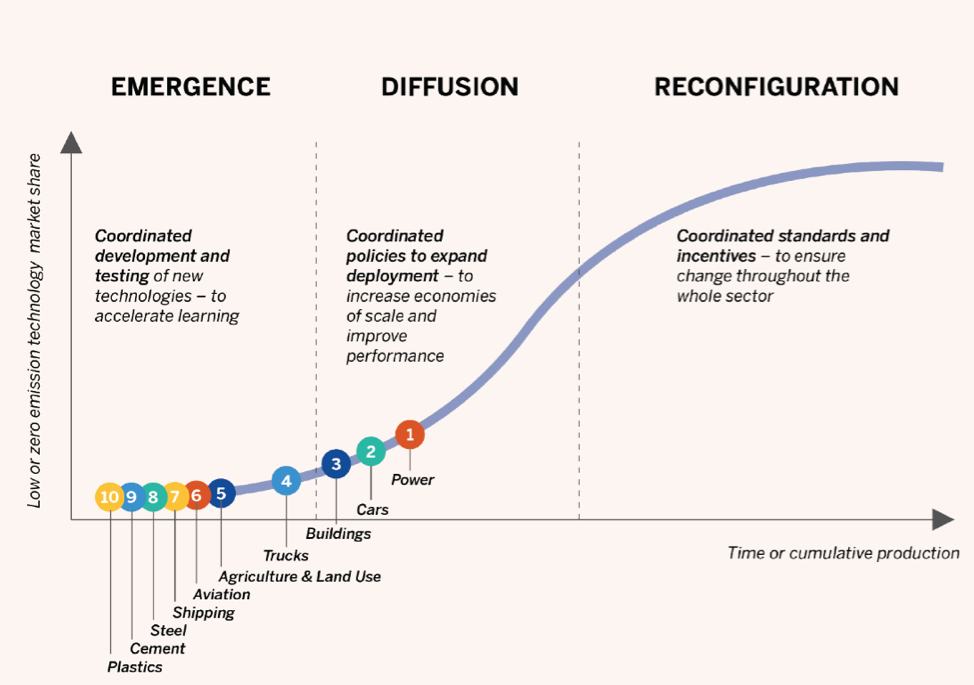
The Decarbonization S-Curve

Reproduced from: Victor, D., F. Geels, and S. Sharpe. 2019. Accelerating the Low Carbon Transition: The case for stronger, more targeted and coordinated international action. Brookings. Available at: https://www.brookings.edu/wp-content/uploads/2019/12/Coordinatedactionreport.pdf. Pg. 14.

The Decarbonization S-Curve illustrates the pace at which zero emission technologies are adopted, which is neither smooth nor steady. Consequently, neither are emission reductions. The graph’s horizontal axis shows time, and the vertical axis indicates how widely used the technology becomes. Adoption is slow at first; the unproven technology struggles to find investors. As government investment, research and development spending, and other subsidies begin, adoption picks up as more firms invest to earn profits from selling the technology. Finally, the takeoff proceeds rapidly as new markets and industries develop, before slowing down as the market matures. It is in the takeoff stage at which the pace of emissions reduction is at its fastest. According to a study published in Research Policy on green technologies in Austria, the takeoff stage can only happen when politics and policy work effectively with the new technology.

In other words, the takeoff of emissions reduction from new technologies does not happen automatically and can be stopped. For example, administrative hurdles to connecting solar and storage projects to the electric grid could result in long waiting times. A shortage of charging stations or battery materials could hamper electric car purchases. According to a report by Brookings, to achieve ambitious emissions reductions governments must pursue R&D policies in the early stages, use capital grants and investment in the takeoff stage, and anchor the market with regulations and standards by the final stage—. If these problems are not addressed, we might find that progress towards our climate goals grinds to a halt. Just because emission reductions can be quick, it does not mean they will be.

Chirag Lala

Researcher


This is a part of the AEC Blog series

tags: Chirag Lala
Tuesday 08.09.22
Posted by Liz Stanton
 

Current Clean Energy and Emission Reduction Goals

Map 1. Clean energy and emission reduction goals across the United States.

Data sources: (1) National Conference of State Legislators. August 13, 2021. “State Renewable Portfolio Standards and Goals.” Available at: https://www.ncsl.org/research/energy/renewable-portfolio-standards.aspx. (2) Center for Climate and Energy Solutions. Last updated March 2021. “U.S. State Greenhouse Gas Emissions Targets.” Available at: https://www.c2es.org/document/greenhouse-gas-emissions-targets/. (3) Clean Energy States Alliance. N.d. “100% Clean Energy Collaborative –Table of 100% Clean Energy States.” Available at:  https://www.cesa.org/projects/100-clean-energy-collaborative/table-of-100-clean-energy-states/. Map last updated July 2022.

Currently, 32 states and the District of Columbia (DC) have renewable portfolio standards (RPS), standards that require a specific percentage of renewable energy in an electricity sale. Twenty-six states and DC have emission reduction targets , 18 states and DC have clean energy targets, and 21 states and DC aim to achieve either a 100 percent emission reduction or a 100 percent clean energy goal.

 In response to climate change, emission reduction and clean energy goals have become increasingly common, and many states that have adopted RPS do not yet have either an emission reduction or a clean energy goal. The first RPS policy can be dated back to 1983 when Iowa passed the Alternative Energy Production Law, which required the state’s investor-owned utilities to purchase an average of 105 megawatts of electricity from renewable energy sources. It was not until twenty years later that Maine enacted the nation’s first greenhouse gas emission reduction legislation in 2003. According to an article in The Energy Journal, states that have adopted RPS policies were likely driven by factors like “strong renewable potential, a restructured electricity market, a small share of natural gas in the electricity fuel mix, strong Democratic presence in the state legislature, and organized renewable energy interests.” This may explain why some states have adopted RPS policies but not yet emission reduction or clean energy targets: RPS legislation can be driven by politics, private interests, or renewable energy potential.

Grace Wu

Research Assistant


This is a part of the AEC Blog series

tags: Grace Wu
Friday 07.29.22
Posted by Liz Stanton
 

Peaker Plant Pollution: Ways to Beat the Peak

Reproduced from: PSE Healthy Energy. 2020. “Massachusetts Peaker Power Plants: Energy Storage Replacement Opportunities”. Available at: https://www.psehealthyenergy.org/wp-content/uploads/2020/05/Massachusetts.pdf

Massachusetts is home to 23 peaker plants across the Commonwealth. “Peaker” plants are electric generators that are called upon during times of maximum customer demand, which typically occurs between 4 PM and 9 PM on weekdays. Peakers produce the highest levels of emission when run compared to other plants on the grid, as they are often older and many use more emissions-intensive fossil fuels like oil, making them less efficient and more costly to operate. Emissions from these plants are linked to a variety of adverse health effects, like asthma and respiratory symptoms.

As hot temperatures, and other extreme weather, lead to spikes in energy demand, Massachusetts will see increasingly higher electric demand on hot summer days. However, there are steps consumers can take to reduce peak demand and associated peaker plant pollution. Text and email alerts such as Shave The Peak from the Green Energy Consumer Alliance or the Metropolitan Area Planning Council’s Peak Electricity Demand Notification program let consumers known when it’s a peak days so that they can reduce energy use. Mass Save, a Massachusetts initiative aimed at helping residents with energy efficiency improvements, offers rebates to control household smart thermostats during peak times to help reduce demand. Consumers can also help reduce the peak by shifting when they use appliances, charging electric cars off peak, and generally reducing electricity consumption during peak windows.

Jordan Burt

Research Assistant


This is a part of the AEC Blog series

tags: Jordan Burt
Wednesday 07.20.22
Posted by Liz Stanton
 

Carbon Emissions and the Courts: The Impacts of the Supreme Court's Decision in West Virginia v. EPA

Chart: Emily Barone. Source: EIA. Retreived from https://time.com/6192800/supreme-court-epa-emissions-ruling/

On June 30, 2022, the Supreme Court delivered a ruling that had long been awaited by climate advocates, policymakers, and industry. The Court voted 6-3 in favor of West Virginia in the case West Virginia v. EPA, effectively ending the EPA’s ability to regulate carbon emissions from power plants through the Clean Air Act.

The ruling significantly impedes the Biden Administration’s goal of reducing carbon emissions by approximately 50 percent from 2005 levels by 2030 and achieving zero carbon emissions by 2050. Meanwhile, the effects of climate change are increasingly evident: storms are becoming stronger and more intense, droughts are exacerbated by climate-driven weather pattern changes, and scorching heatwaves are becoming more common even in summer months.

Following the COVID-19 shutdowns in 2020, national greenhouse gas emissions continue to rise (see graph above) after years of trending downward, and the Supreme Court’s ruling poses yet another hurdle to reducing U.S. greenhouse gas emissions. The confluence of increasingly frequent climate change-driven weather events, increasing carbon emissions, and the reduced ability to regulate carbon emissions from power plants will disproportionately impact underserved and under-resourced communities. A 2021 EPA report found that predominantly Black communities are at the highest risk of experiencing the most negative health and environmental threats posed by climate change, and it also found that predominantly Hispanic and Latinx communities are more likely to be exposed to increasingly frequent extreme temperatures and coastal flooding. The window of opportunity to mitigate the worst effects of climate change is rapidly closing, and there is not a minute to waste.

Levi Bevis

Communications Assistant


This is a part of the AEC Blog series

tags: Levi Bevis
Wednesday 07.13.22
Posted by Liz Stanton
 
Newer / Older