• Home
  • About
    • Mission and Funding
    • Our People
    • 990 Filings
    • Governance and Disclosure Statements
  • Our Work
    • Areas of Expertise
    • Publications
    • Testimonials
  • Jobs
    • Internships
    • Careers
  • Pro Bono Fund
    • Pro Bono Fund
    • Donate
  • Seminars
    • Upcoming Seminars
    • Seminar Archive
  • Resources
    • Maps Archive
    • Equity Resources
    • Newsletters
    • Blog
  • Do Work With Us
Applied Economics Clinic
  • Home
  • About
    • Mission and Funding
    • Our People
    • 990 Filings
    • Governance and Disclosure Statements
  • Our Work
    • Areas of Expertise
    • Publications
    • Testimonials
  • Jobs
    • Internships
    • Careers
  • Pro Bono Fund
    • Pro Bono Fund
    • Donate
  • Seminars
    • Upcoming Seminars
    • Seminar Archive
  • Resources
    • Maps Archive
    • Equity Resources
    • Newsletters
    • Blog
  • Do Work With Us

Testimony on Southwestern Public Service Company's (SPS) Application to Construct New Generation Facilities

Client: Sierra Club

Authors:
Bryndis Woods, PhD

February 2026

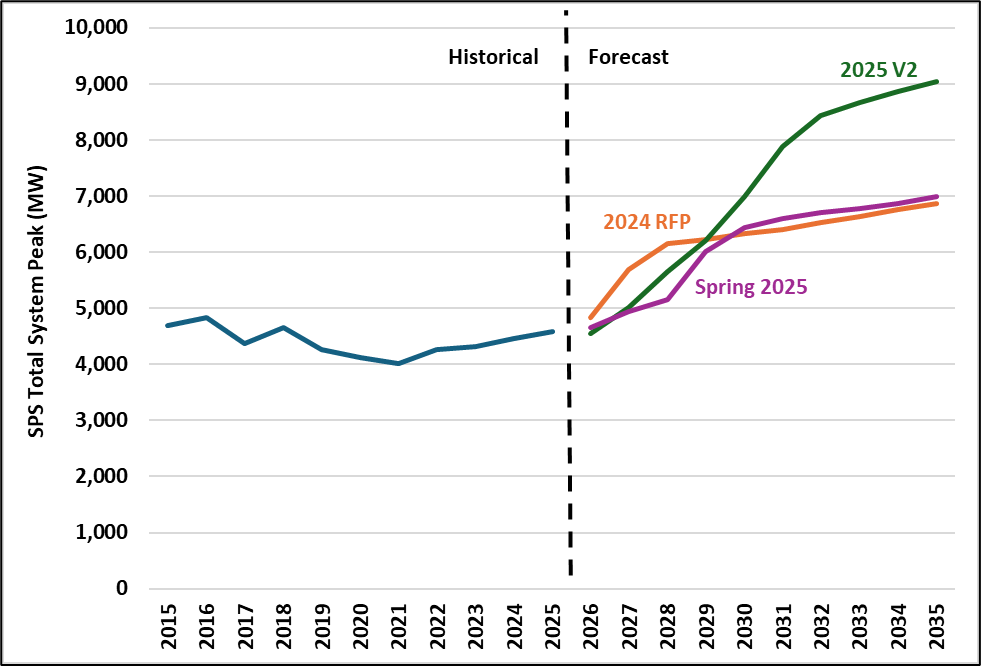
On behalf of Sierra Club, Principal Analyst Dr. Bryndis Woods filed testimony before the Texas Public Utility Commission regarding SPS's Application to amend its Certificate of Convenience and Necessity (CCN) to construct eight new generation facilities totaling over 4,100 megawatts in Texas and New Mexico. 

Dr. Woods' direct testimony evaluates three issues in SPS’s Application: 1) the claim that additional generating capacity is needed to serve large-load interconnection requests; 2) the Company's approach to pursuing solar and wind resources; and 3) the potential impacts of the forthcoming expansion of SPS’s regional grid operator, Southwest Power Pool (SPP). Dr. Woods' recommendations included that the Commission require SPS: include only contractually committed new loads in its base load forecast; establish consumer protections for new large loads; utilize available surplus interconnection capacity to develop additional wind and solar projects; and assess the potential impacts of SPP's expansion.

Dr. Woods' cross-rebuttal testimony focused on additional issues in the proceeding, including that: SPS's Island Case modeling should not be used to make determinations regarding resource reliability; battery storage projects contribute significantly to grid reliability during extreme winter weather events; new gas pipeline capacity in the Permian Basin favors retirement of coal-fired units at the Tolk plant; and any extension of Tolk's coal-fired units would entail significant costs. 
Link to Direct Testimony

Link to Cross-Rebuttal Testimony

Return to Our Work

tags: Bryndis-Woods
Friday 02.27.26
Posted by Liz Stanton
 

Risks of New Gas-Fired Generation in Arizona

Client: Western Resource Advocates (WRA)

Authors:
Bryndis Woods, PhD, Elisabeth Seliga, Alicia Zhang, Brady Dye, and Elizabeth A. Stanton, PhD

February 2026

On behalf of Western Resource Advocates (WRA), a new AEC report assesses the risks associated with new gas-fired electric generation in Arizona.

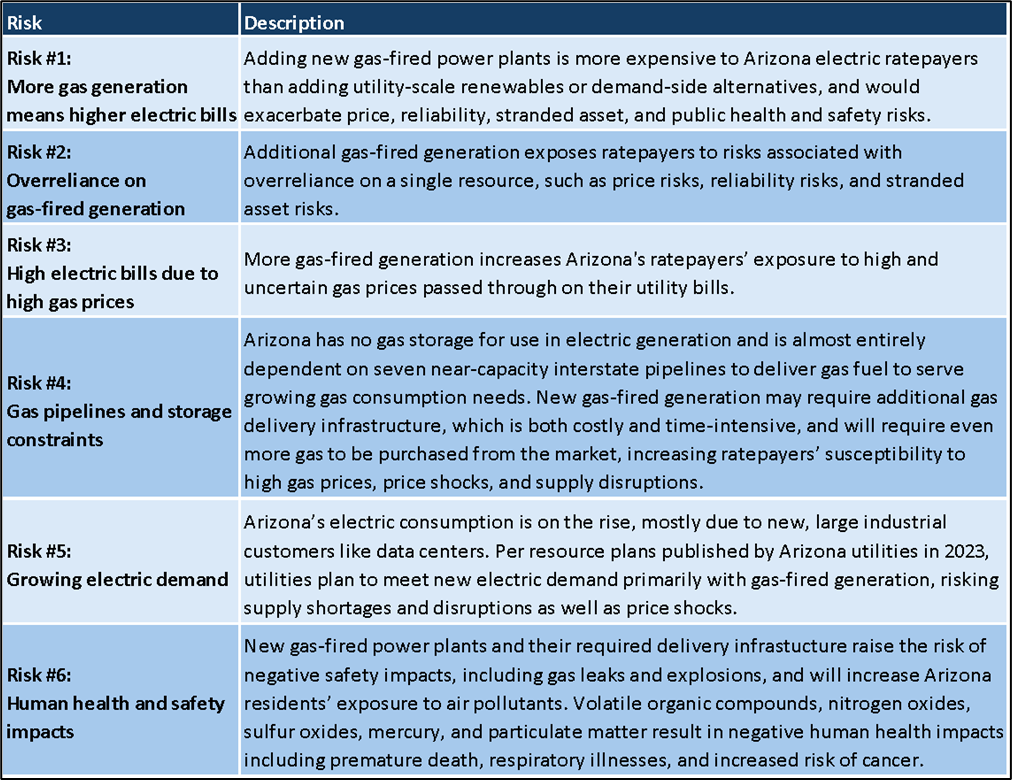
The report finds that Arizona’s electric sector is dominated by gas-fired resources and much more gas-fired capacity is currently proposed. Arizona’s utilities claim that new gas-fired generation is needed to address reliability challenges and meet anticipated growth in electric demand. However, the report finds that building new gas-fired generation hurts reliability and exposes Arizona’s residents and ratepayers to six serious risks: 1) More gas generation means higher electric bills; 2) Overreliance on gas-fired generation; 3) High electric bills due to high gas prices; 4) Gas pipelines and storage constraints; 5) Growing electric demand; and 6) Human health and safety impacts.

The report concludes that, rather than furthering reliance on gas, Arizona’s utilities should instead prioritize resources that stand to benefit the state’s residents and ratepayers. Solar, wind, battery storage, energy efficiency, and demand-side management resources lower costs, diversify Arizona’s energy mix, are not reliant on fuel supply, and reduce pollution.

Link to Report

Return to Our Work

tags: Bryndis-Woods, Elisabeth Seliga, Alicia-Zhang, Brady-Dye, Liz-Stanton
Friday 02.06.26
Posted by Liz Stanton
 

Evaluating Load Management Strategies for a Net Zero Grid in Massachusetts

Client: Massachusetts Department of Energy Resources (DOER)

Authors:
Bryndis Woods, PhD and Tanya Stasio, PhD

December 2025

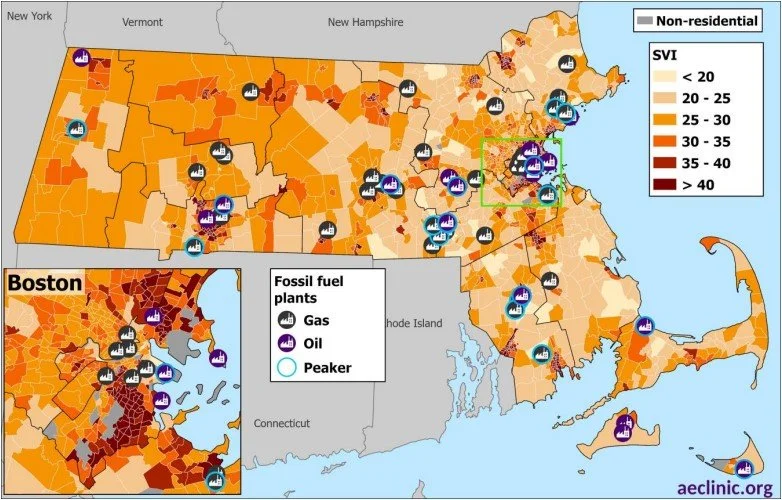
On behalf of the Massachusetts Department of Energy Resources (DOER), Principal Analyst Bryndis Woods, PhD and Senior Researcher Tanya Stasio, PhD contributed to an assessment of load management potential in Massachusetts in futures aligned with deep decarbonization and the Commonwealth’s Climate and Clean Energy Plan (CECP) goals. The assessment was led by Energy + Environmental Economics (E3) and AEC supported by leading the development of resiliency and equity impacts of load management resource deployment and managing the advisory group and stakeholder sessions.

AEC managed a total of four advisory group meetings and two public stakeholder workshops between May and September 2025. AEC's analysis included the development of a Social Vulnerability Index (SVI) that identified disadvantaged communities in Massachusetts by assessing their vulnerability across ten measures (e.g. income, race/ethnicity, energy burden). We find that mindful design of programs to support load management strategies can improve outcomes for disadvantaged communities (e.g. reduced energy burden, reduced outages).

Link to Report

Link to DOER Project Webpage

Return to Our Work

tags: Bryndis-Woods, Tanya-Stasio
Thursday 12.18.25
Posted by Liz Stanton
 

Lower Heating Costs with Thermal Networks

Client: Green Energy Consumers Alliance (GECA) and Black Swan Lab

Authors:
Sagal Alisalad and Joshua R. Castigliego

December 2025

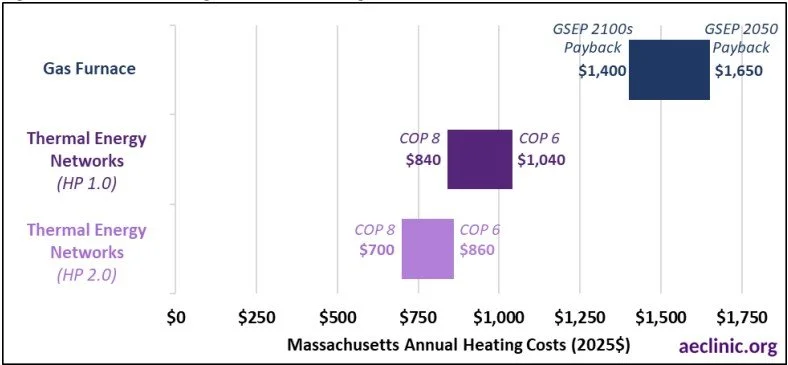
On behalf of Green Energy Consumers Alliance (GECA) and Black Swan Lab, Researcher Sagal Alisalad and Senior Researcher Joshua R. Castigliego prepared a white paper analyzing the near-term operational costs of heating for an average Massachusetts household using thermal energy networks compared to gas furnaces. AEC examined two seasonal heat pump rate scenarios for thermal energy networks with a range of efficiency levels from a coefficient of performance (COP) between 6 and 8: (1) HP 1.0: Massachusetts Department of Public Utilities (DPU)-approved seasonal heat pump rates, and (2) HP 2.0: Massachusetts Department of Energy Resources (DOER)-proposed seasonal heat pump rates. The analysis highlights thermal energy networks as the far more cost-effective and energy-efficient choice for an average-sized, average-energy-use household.

Link to White Paper

Return to Our Work

tags: Sagal-Alisalad, Joshua-Castigliego
Friday 12.05.25
Posted by Liz Stanton
 

GreenRoots’ Pathway to Interconnection

Client: GreenRoots

Authors:
Sagal Alisalad and Bryndís Woods, PhD

November 2025

On behalf of GreenRoots, Researcher Sagal Alisalad and Principal Analyst Bryndís Woods, PhD, prepared a report summarizing GreenRoots’ experience applying to interconnect three behind-the-meter (BTM) projects to the electric grid: 1) Chelsea City Hall (solar and storage), 2) Chelsea Police Department (solar and storage), and 3) Municipal Public Works Yard (rooftop solar). AEC examined the obstacles and complexities of the interconnection process for small- and medium-sized customers like GreenRoots. This analysis highlights how these barriers hinder a community’s ability to develop community-owned BTM resources.

AEC recommends that decision-makers, utilities, and communities collaborate to address barriers to interconnection in order to boost community resiliency, support the clean energy transition, help the Commonwealth reach its clean energy and emission reduction goals, and ensure energy systems in the Commonwealth benefit everyone.

Link to Report

Return to Our Work

tags: Sagal-Alisalad, Bryndis-Woods
Friday 11.21.25
Posted by Liz Stanton
 

Assessing the Net Emissions Benefit for Clean Energy Facilities in Rochester, Massachusetts

Client: New Leaf Energy, Inc.

Authors:
Joshua R. Castigliego and Jordan Burt, PhD

November 2025

On behalf of New Leaf Energy, Inc., Senior Researcher Joshua R. Castigliego and Researcher Jordan Burt, PhD conducted an analysis estimating the net change in carbon dioxide (CO2) emissions associated with New Leaf Energy’s two proposed clean energy facilities on High Street in Rochester, Massachusetts. Each proposed facility will house solar photovoltaics (PV) and an energy storage system (ESS) (collectively referred to as a “PV+ESS facility”). Development of Site A requires clearing approximately 23.5 acres of forested land, while Site B requires clearing of approximately 20.6 acres.

AEC estimated the net emission impact of the Site A and Site B PV+ESS facilities by combining (1) “positive” CO2 emissions savings (i.e., reduced emissions) from the electric grid due to renewable energy generation and (2) “negative” CO2 emissions (i.e., increased emissions) due to land-use conversion from forestland to grassland. When these two factors are considered together, the proposed facilities yield substantial net emissions savings (i.e., reduced emissions). AEC’s analysis indicates that the facilities’ grid emissions reductions would outweigh added, by a factor 4.9 times greater for Site A and 4.3 times greater for Site B.

Link to Site A Report

Link to Site B Report

Return to Our Work

tags: Joshua-Castigliego, Jordan Burt, Renewable Energy, Net emissions and avoided emission analysis
Wednesday 11.19.25
Posted by Liz Stanton
 

Consumers Energy 2025 Rate Case

Client: Michigan Environmental Council and Citizens Utility Board of Michigan

Authors:
Tyler Comings

November 2025

Principal Economist Tyler Comings filed testimony before the Michigan Public Service Commission on the Consumers Energy 2025 rate case, on behalf of Michigan Environmental Council and Citizens Utility Board of Michigan. Mr. Comings addressed the risks of further gas investment given the pressure on prices from LNG exports. He also recommended disallowance of two capital projects at the Jackson gas plant due to flaws and lack of support in the company's economic assessments for those projects. 

Link to Testimony

Return to Our Work

tags: Tyler-Comings
Tuesday 11.18.25
Posted by Liz Stanton
 

Testimony on Entergy Arkansas’ Request for a Certificate of Environmental Compatibility and Public Need

Client: Arkansas Electric Energy Consumers, Inc. (AEEC)

Authors:
Liz Stanton, PhD

September 2025

On behalf of Arkansas Electric Energy Consumers, Inc. (AEEC), Principal Economist Elizabeth A. Stanton, PhD submitted direct testimony before the Arkansas Public Service Commission to assess Entergy Arkansas, LLC’s request for a Certificate of Environmental Compatibility and Public Need (“CECPN”) and a Certificate of Convenience and Necessity (“CCN”) in Docket No. 25-047-U. In this case, the Company requests approval for the construction and operation of Jefferson Power Station, a 754-megawatt gas-fired combined cycle combustion turbine (“CCCT”) at its existing White Bluff site. In her testimony, Dr. Stanton reviews the Company’s need for additional generation resources, its evaluation of alternative supply-side resource options, and the adequacy of its recent request for proposal (“RFP”) process.

Dr. Stanton recommends that the Commission reject the application for a CECPN as incomplete and require Entergy Arkansas to: reapply with all the information necessary to provide clear evidence that it requires additional capacity and/or generation at this time, and that the Jefferson Power Station represents the least-cost option; provide supplemental materials supporting the need for the project; conduct an all-resource RFP and make its results available to stakeholders; present cost and feasibility comparisons of resources not sited at White Bluff and resources other than natural gas-fired combined cycle combustion turbines. She also recommends that the Commission request that the Arkansas State Legislature reconsider its imposition of a six-month timeframe for CECPN cases.

Link to Testimony

Link to Surrebuttal

Return to Our Work

tags: Liz-Stanton
Friday 09.12.25
Posted by Liz Stanton
 

Xcel Colorado Resource Plan Testimony

Client: Sierra Club and Natural Resources Defense Council (NRDC)

Authors:
Tyler Comings

September 2025

Principal Economist Tyler Comings provided testimony before the Colorado Public Utilities Commission on resource plan modeling done by Public Service Company (or Xcel Colorado). Mr. Comings found that the utility should make many changes to its modeling methodology including allowing market access, justifying that new gas resources will be carbon-free, and correctly discounting social costs of carbon and methane. 

Link to Testimony

Return to Our Work

tags: Tyler-Comings
Thursday 09.11.25
Posted by Liz Stanton
 

Duke Indiana Resource Plan Comments

Client: Sierra Club

Authors:
Tyler Comings, Joshua R. Castigliego, and Jordan Burt, PhD

September 2025

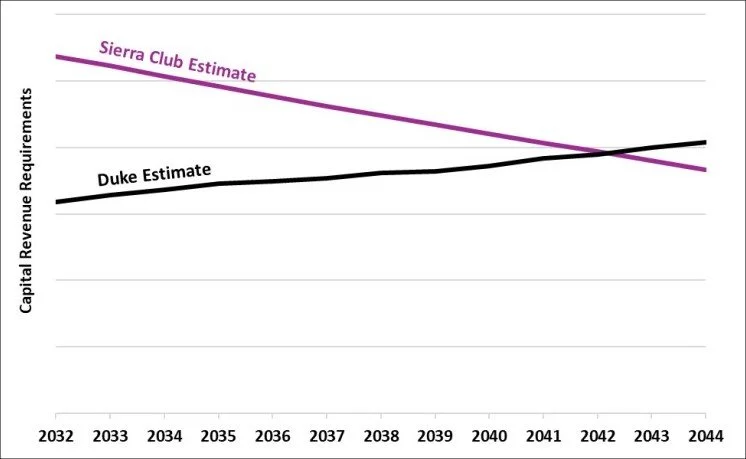
Principal Economist Tyler Comings, Senior Researcher Joshua Castigliego, and Researcher Jordan Burt, PhD, co-wrote comments on the Duke Energy Indiana 2024 Integrated Resource Plan (IRP) with Sierra Club. The comments argue that Duke should have chosen a different preferred plan that was lower-cost and lower-risk--a portfolio with a lower gas buildout and that converted the Edwardsport coal plant to natural gas as soon as feasible.

Link to Comments

Return to Our Work

tags: Tyler-Comings, Joshua-Castigliego, Jordan Burt
Thursday 09.11.25
Posted by Liz Stanton
 

Ameren Missouri Rate Case Testimony

Client: Sierra Club

Authors:
Tyler Comings

September 2025

Principal Economist Tyler Comings provided testimony before the Missouri Public Service Commission on the utility's proposed return on equity (ROE) and economics of its coal units. Mr. Comings found that the utility's proposed ROE of 10.25 percent was too high, finding that using more reasonable assumptions and methods would lead to an ROE between 9.25 and 9.5 percent. He also argued that the Sioux coal units were costly and unreliable which should lead Ameren to consider their earlier retirement. 

Link to Direct Testimony

Link to Surrebuttal Testimony

Return to Our Work

tags: Tyler-Comings
Thursday 09.11.25
Posted by Liz Stanton
 

Accounting for Indirect Fiscal Impacts in Connecticut’s Legislative Review

Client: Connecticut Roundtable on Climate and Jobs (CRCJ)

Authors:
Jordan Burt, PhD, Elisabeth Seliga, and Joshua R. Castigliego

August 2025

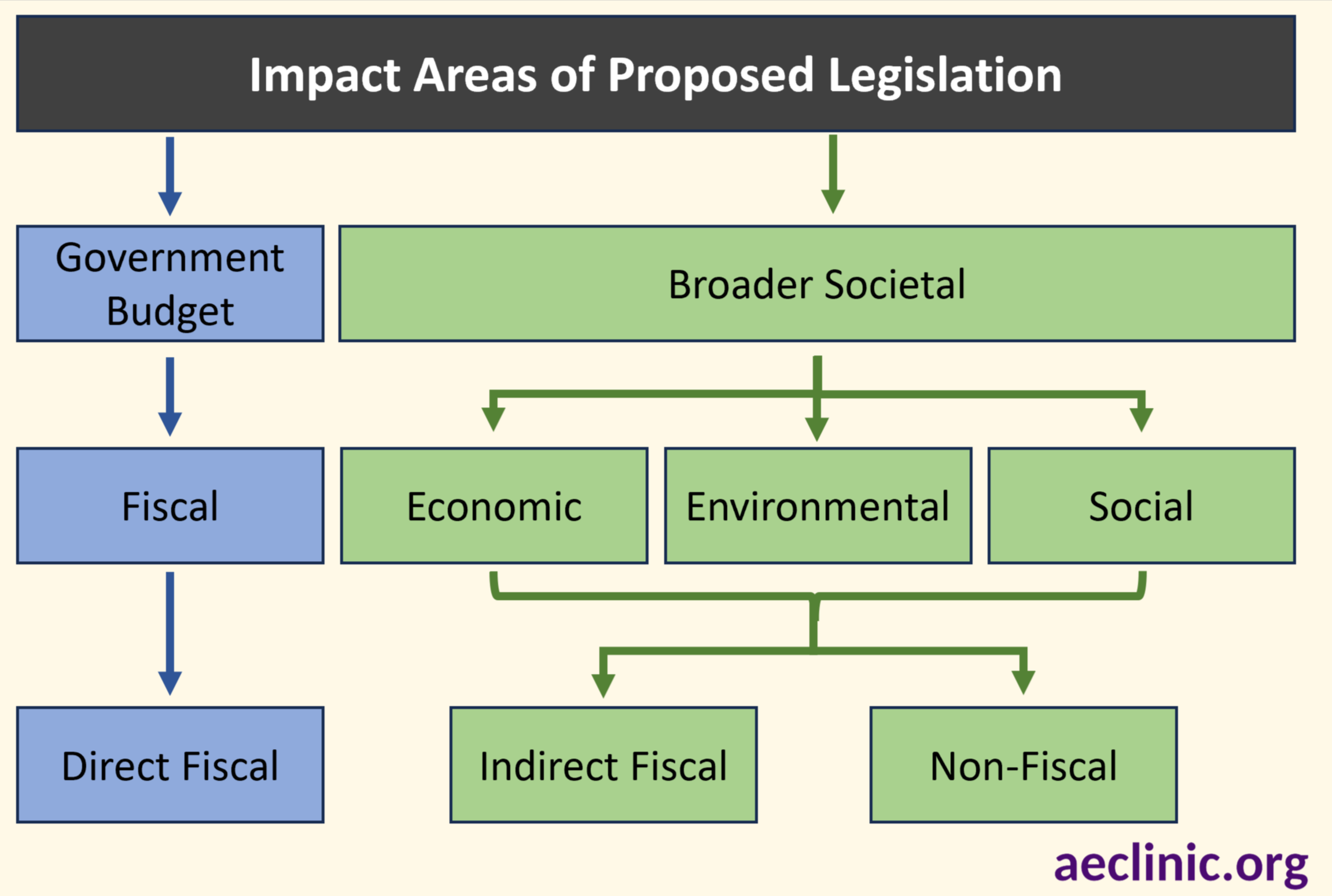
On behalf of the Connecticut Roundtable on Climate and Jobs (CRCJ), Researcher Jordan Burt, PhD, Assistant Researcher Elisabeth Seliga, and Senior Researcher Joshua R. Castigliego prepared a policy brief that evaluates the use of fiscal notes in Connecticut’s legislative review process and identifies the key limitations in capturing the full extent of a bill’s impact in Connecticut. Fiscal notes summarize the expected impacts on government revenues and expenditures, helping lawmakers evaluate a bill’s impact on government budgets. To best inform decision-making, fiscal notes must accurately reflect the true cost of legislation. In Connecticut, fiscal notes exclude indirect fiscal impacts. The result is a misestimation of a bill’s effect on the state’s budget that can result in beneficial proposals being rejected or flawed legislation being passed. As a first step toward improving the accuracy of fiscal notes, AEC recommends that Connecticut adopt “enhanced fiscal notes” that incorporate both direct and indirect fiscal costs to provide a more complete picture of a bill’s fiscal consequences during the legislative review process.

Link to Policy Brief

Link to Summary

Return to Our Work

tags: Jordan Burt, Elisabeth Seliga, Joshua-Castigliego
Wednesday 08.27.25
Posted by Liz Stanton
 

Equity Advisory Working Group Recommendations: Equity Metrics for the District of Columbia's Benefit-Cost Analysis Model and Stakeholder Engagement for Utility Planning

Client: Public Service Commission of the District of Columbia (DC PSC)

Authors:
Bryndis Woods, PhD, Elizabeth A. Stanton, PhD, Sagal Alisalad, Alicia Zhang, Jordan Burt, PhD, and Elisabeth Seliga

July 2025

On behalf of the Public Service Commission of the District of Columbia (DC PSC), AEC—together with our partner Visionary Leadership Group—convened and facilitated a seventeen-member Equity Advisory Working Group (EAWG) to recommend: 1) Criteria for designating Priority Populations in the District; 2) Racial equity, energy burden, and low- and moderate-income metrics for inclusion in the District’s evaluation framework for utility proposals; and 3) A stakeholder accountability process to facilitate local resident engagement and representation in utility proposal decision-making processes. EAWG members attended 10 meetings between January and May 2025. At each meeting, EAWG members were given presentations and supporting materials developed by AEC to ensure that all EAWG members had the information they required to make their recommendations, such as how BCAs work for proposed utility programs, or examples of  equity metrics from the publicly available literature. AEC was also responsive to requests from EAWG members, such as by designing and modifying priority population definitions, providing equity metric methods and data, and presenting map visualizations of how different priority population definitions capture different District communities. The report presents the EAWG’s 29 recommendations which—if adopted—will help ensure that social and racial equity are included in electric and gas utility planning processes and that the disproportionate and systemic harms related to the current energy system, climate change, and environmental injustice are considered and addressed for all District communities.

Errata: On page 55 of the report, it states that "15 percent of DC households are classified as low income." This should read "19 percent of DC households are classified as low income." On page 57 of the report, it state that "The District’s moderate-income households make more than $32,000 but less than $88,000—a group that includes 25 percent of households District-wide." This should read "The District’s moderate-income households make more than $32,000 but less than $88,000—a group that includes 32 percent of households District-wide."

Link to Report

Return to Our Work

tags: Bryndis-Woods, Sagal-Alisalad, Jordan Burt, Elisabeth Seliga, Alicia-Zhang, Liz-Stanton
Thursday 07.31.25
Posted by Liz Stanton
 

Amicus Curiae in the Case of Genesis B. v. United States Environmental Protection Agency

Author: Liz Stanton, PhD

July 2025

Principal Economist Elizabeth A. Stanton led AEC Staff in drafting an amicus curiae brief submitted on appeal from the United States District Court for the Central District of California, No. 2:23-cv-10345, in the case of Genesis B. v. United States Environmental Protection Agency (EPA). The Genesis plaintiffs (a group of 18 youths) argued that the EPA violated their right to equal protection of the law through discriminatory discounting of children’s lives when making environmental decisions.

In the brief, the amici curiae contend that discounting practices used by the EPA are detrimental to children and future generations, and that the dismissal of the case “reflects fundamental misunderstandings of the economics of discounting.” The Plaintiffs’ amended complaint challenged the EPA’s policy of positive social discounting, which privileges current adults while giving less weight to today’s children that will be affected by the harms of today’s environmental policies in the future. The brief concludes that the EPA’s current analyses do not give full weight to the long-term benefits of pollution reduction policies enacted now and advises the Court to reverse the District Court’s dismissal.

Signatories to the amicus curiae brief: Dr. Elizabeth A. Stanton, Dr. Eban Goodstein, Dr. Robin Hahnel, Dr. James K. Boyce, Dr. Gerald Epstein, Dr. Michael Ash, Dr. Bryndís Woods, Dr. Jordan Burt, and Dr. Tanya Stasio.

Link to Brief

News:
Economists, physicians and legal scholars back kids climate lawsuit

Return to Our Work

tags: Liz-Stanton, Bryndis-Woods, Jordan Burt, Tanya-Stasio
Friday 07.25.25
Posted by Liz Stanton
 

Alabama Power’s Plant Miller: An Economic Assessment of Alternative Portfolios

Client: Southern Environmental Law Center (SELC)

Authors: Joshua R. Castigliego, Jordan Burt, PhD, and Tyler Comings

July 2025

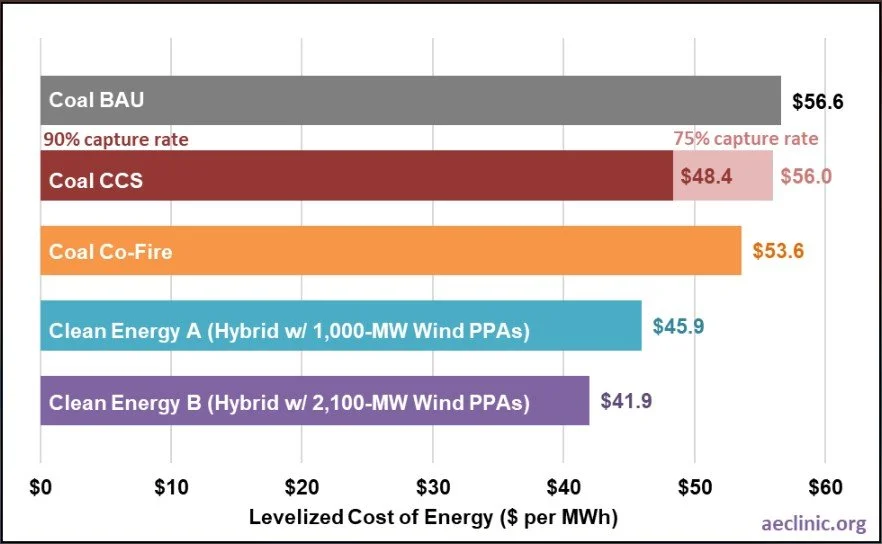
On behalf of the Southern Environmental Law Center, Senior Researcher Joshua R. Castigliego, Researcher Jordan Burt, PhD, and Principal Economist Tyler Comings prepared a report that evaluates four alternative portfolios to demonstrate that the continued business-as-usual (BAU) operation of Alabama Power’s James H. Miller Jr. Electric Generating Plant (also known as “Plant Miller”) is uneconomic and not in the best interest of customers.

One method of comparing alternative resource portfolios is to examine customer costs on a “levelized” basis—which normalizes total costs by total generation (in megawatt-hours or “MWh”) over an assumed time period. The levelized cost of energy (LCOE, in $ per MWh) provides insight into how each of the alternative portfolios compare to one another regardless of the total energy provided by each portfolio. Among its four modeled alternatives, AEC finds that replacing Plant Miller with clean energy and storage resources is cheaper on a levelized cost basis than keeping the plant operational into the 2040s.

Alabama Power should also continually evaluate the costs and risks of keeping the plant on-line by looking at viable alternatives. Although the alternative portfolios presented in this report are meant to be illustrative, the results of the analysis have demonstrated that the continued operation of Plant Miller (with or without carbon sequestration retrofits) is uneconomic, and Alabama Power would be able to provide customers with cost savings by investing further in clean energy resources. In order to determine the most cost-effective replacement of Plant Miller, Alabama Power should periodically conduct capacity expansion modeling that considers the retirement of Plant Miller in the context of the Company’s entire system.

Link to Report

Return to Our Work

tags: Joshua-Castigliego, Jordan Burt, Tyler-Comings
Tuesday 07.08.25
Posted by Liz Stanton
 

Testimony on LG&E-KU’s Certificates of Public Convenience and Necessity and Site Compatibility Certificates

Client: Kentuckians for the Commonwealth, Kentucky Solar Energy Society, Metropolitan Housing Coalition, and Mountain Association

Authors: Liz Stanton, PhD

June 2025

Principal Economist Elizabeth A. Stanton, PhD, submitted direct testimony before the Kentucky Public Service Commission to assess the load forecasting assumptions utilized in the 2025 request for approval for Certificates of Public Convenience and Necessity (CPCN) filed by Louisville Gas and Electric Company and Kentucky Utilities Company (LG&E-KU) in Kentucky PSC Case No. 2025-00045. In her testimony, Dr. Stanton reviews the Companies’ 2025 CPCN Load Forecast and assesses the methodology, assumptions, and findings of their economic development growth forecast, particularly as they related to projected growth in data centers.

Dr. Stanton recommends that the Companies employ a short-term forecast of new data center and other large customer load based on concrete evidence that there is a high likelihood that such load will actually come online, while discounting or excluding possible large customer load that is merely speculative or has a low likelihood of materializing, and presents an alternative framework for using probability weighting to forecast future load growth from data centers.

Link to Testimony

Return to Our Work

tags: Liz-Stanton
Wednesday 06.18.25
Posted by Liz Stanton
 

Basin Electric's Coal Fleet: Risks to Continued Operation and Opportunities for Replacement

Authors: Bryndis Woods, PhD, Joshua R. Castigliego, Jordan Burt, PhD, Elisabeth Seliga

Client: Western Organization of Resource Councils

June 2025

On behalf of the Western Organization of Resource Councils, this AEC report evaluates the risks associated with continued operation of Basin Electric’s coal-fired plants and outlines opportunities for replacement with lower-cost clean energy resources. The continued operation of Basin Electric’s coal plants entails important risks to Basin Electric, its members and members’ ratepayers, including risks presented by: 

  1. Federal oversight: In 2019, Basin Electric became subject to Federal Energy Regulatory Commission (FERC) oversight, which means Basin Electric is facing greater scrutiny of whether continued operation of its coal plants is most prudent for its members and their ratepayers. 

  2. Competition in Southwest Power Pool (SPP): Basin Electric’s forthcoming full membership in the Southwest Power Pool (SPP) risks that Basin Electric’s coal plants will operate less often because more of its coal generation will compete in every hour of the day with every other resource in SPP’s marketplace.

  3. Environmental regulations: There are cost risks for Basin Electric’s coal-fired power plants related to new emission and pollution control technologies to comply with federal environmental regulations including: the Regional Haze Rule, the coal ash waste rules, and carbon pollution standards.

AEC finds that Basin Electric can hedge against risks to its coal-fired resources by taking advantage of cost-saving opportunities to replace coal resources with cheaper wind and solar resources—resources which become even more cost-effective when coupled with federal incentives, funding, and financing streams targeted specifically at electric cooperatives to pursue them. 

Link to Report

Return to Our Work

tags: Bryndis-Woods, Joshua-Castigliego, Jordan Burt, Elisabeth Seliga
Monday 06.16.25
Posted by Liz Stanton
 

Assessing U.S. Electric Grid Operators' Governance: Transparency, Accessibility, Accountability

Authors: Bryndis Woods, PhD, Deja Garraway, Alicia Zhang, PhD, Sagal Alisalad, Sumera Patel

Client: Slingshot

May 2025

On behalf of Slingshot (and their participation in the broader, grassroots Fix the Grid campaign in New England), this AEC report card utilized approximately 250 sources—including grid operator documents, research reports, and expert testimony—to develop and assign points across 34 metrics among three categories: 1) transparency is making information and materials publicly available; 2) accessibility is facilitating public awareness and involvement in grid operator processes; and 3) accountability is structuring governance and decision-making processes to incorporate viewpoints reflective of the diversity of the communities in each grid operator's territory. 

The primary finding of the report card is that none of the seven U.S. grid operators perform particularly well in any assessment category and there is considerable room for improvement across grid operators in terms of transparency, accessibility, and accountability. The highest overall grade was a C+ earned by CAISO due to its strong performance in the accountability category. The lowest overall grade was an F earned by ISO-NE due to its receiving a failing grade in the accessibility and accountability categories. The five remaining grid operators (PJM, MISO, SPP, ERCOT and NYISO) each received an overall grade ranging from C- to D-.

Link to Report

Link to Workbook

News: Consumer Liaison Group Discusses ISO-NE’s Failing Accessibility Grade, June 4, 2025

News:
ISO-NE should make its governance transparent, accessible and accountable, August 13, 2025

Return to Our Work

tags: Bryndis-Woods, Deja Garraway, Alicia-Zhang, Sagal-Alisalad, Sumera-Patel
Tuesday 05.13.25
Posted by Liz Stanton
 

Clean Energy Expansion: Recommendations for Georgia Power

Authors: Tanya Stasio, PhD, Jordan Burt, PhD, and Elisabeth Seliga

May 2025

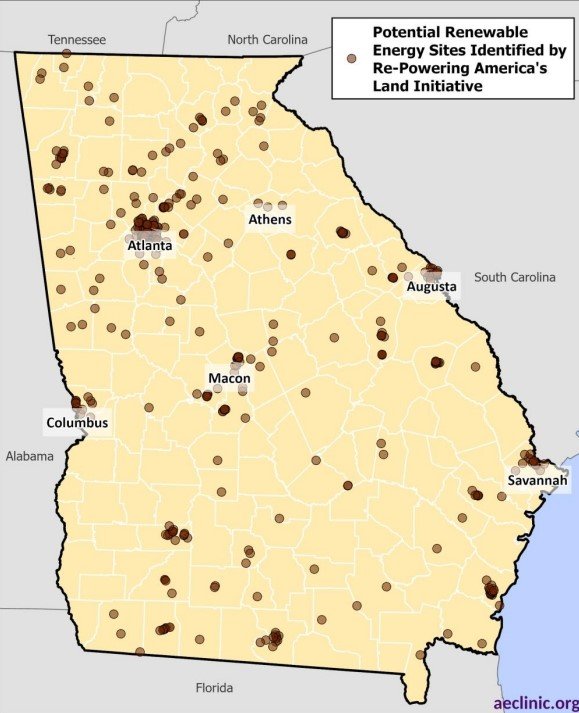
Senior Researcher Tanya Stasio, PhD, Researcher Jordan Burt, PhD, and Assistant Researcher Elisabeth Seliga prepared a report that reviews the Georgia clean energy policy landscape, assesses Georgia Power’s existing fossil fuel-fired power plants and reviews Georgia Power clean energy program offerings. AEC identifies several sites of Georgia Power-owned retired and operating fossil-fuel energy infrastructure and recommends that Georgia Power consider replacing these sites with clean energy sources such as a solar plus storage facility. In addition, AEC recommends the Company re-assess retirement plans for fossil fuel plants with higher environmental costs that are expected to operate past 2025. Lastly, AEC provides recommendations to expand Georgia Power’s clean energy program offerings and increase customer participation in its existing programs.

Link to Report

Return to Our Work

tags: Elisabeth Seliga, Tanya-Stasio, Jordan Burt
Friday 05.09.25
Posted by Liz Stanton
 

Identifying Priority Areas for Clean Energy Expansion and Emissions Reduction Opportunities

Authors: Tanya Stasio, PhD, Elisabeth Seliga, Elizabeth A. Stanton, PhD

April 2025

Senior Researcher Tanya Stasio, PhD, Assistant Researcher Elisabeth Seliga, and Principal Economist Elizabeth A. Stanton, PhD, prepared a white paper that provides energy, economic, environmental, and equity criteria that can be used by states, regional organizations, or other entities to identify priority areas for clean energy expansion and emissions reduction efforts within a particular jurisdiction. In addition to providing a pathway for identifying efficient and equitable locations for clean energy expansion efforts, these criteria may be helpful for prioritizing efforts to secure funding to support clean energy projects.

Link to White Paper

Link to Workbook Template

Return to Our Work

tags: Liz-Stanton, Elisabeth Seliga, Tanya-Stasio
Thursday 04.17.25
Posted by Liz Stanton
 
Newer / Older